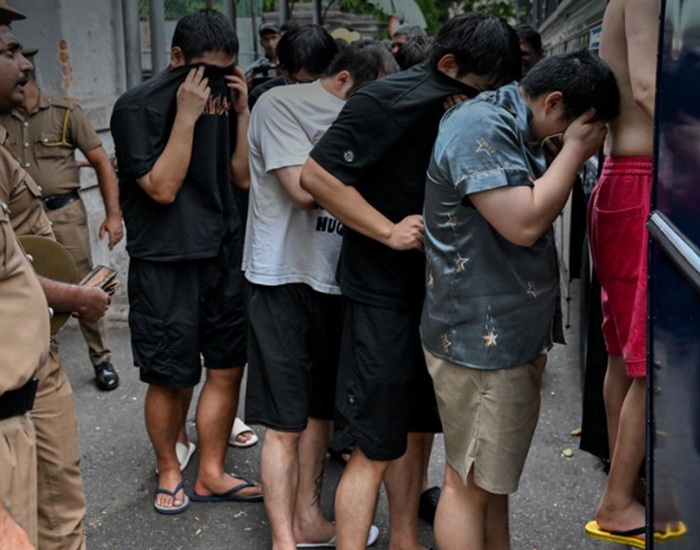
Bloomberg has identified Sri Lanka as an emerging base for Asia’s online scam networks, citing the crackdown on scam compounds in Cambodia as the catalyst pushing gangs to relocate to beach resorts and office buildings on the island, Newswire reported.
A combination of visa-free travel, available building space, relatively strong telecommunications networks and a well-established informal money transfer system make the country an appealing destination for scammers, investigators told Bloomberg.
Police have set up a new cybercrimes unit and arrested more than 1,000 people this year alone, most in western beach areas where tourists congregate or in Colombo. “Police, along with the immigration department and the central bank, are working as a collective effort to see that this is being controlled,” Assistant Superintendent of Police Fredrick Wootler said.
The report cites a string of recent raids — including one west-coast property in April where police found more than 150 foreign nationals allegedly running a cyber-scam operation, and a multistorey Colombo apartment building raid days later that netted another 120 foreign nationals. As authorities have ramped up enforcement, operators appear to be shifting away from large compounds towards hotels, apartment buildings and office space that can be rented quickly and abandoned just as fast.
“In Sri Lanka there are issues with implementing our laws, the fact that we don’t necessarily crack down on these companies — they simply use tourist visas,” Dilrukshi Handunnetti, director at the Centre for Investigative Reporting Sri Lanka, told Bloomberg. “This is happening in ways that are unfortunately even more difficult for us to keep our eyes on,” added Erin West, founder of anti-scam non-profit Operation Shamrock. “I think we’ve created such skilled workers, whether they wanted to be or not, that they can operate really in any kind of environment.”
The Bloomberg framing follows an AFP report in May that captured the same displacement pattern and pushes Sri Lanka into a broader international narrative previously focused on the United Arab Emirates, Timor-Leste, Fiji and parts of Africa. A US congressional committee report cited by Bloomberg warned in July last year that fraud networks were relocating to environments marked by “regulatory stress” — jurisdictions with weak enforcement but strong digital infrastructure.
China is among the governments paying attention. The Chinese embassy in Colombo released a statement in mid-March saying it was “closely following” reports of arrests of suspected scammers, after Chinese pressure earlier helped push Cambodia to clamp down. Local enforcement has scaled markedly this year, with a 198-foreigner Galle-Hikkaduwa-Midigama sweep and the 54-foreigner Hikkaduwa STF raid anchoring the public arrest tally. Police have also warned landlords that facilitating scam operators could attract legal liability.