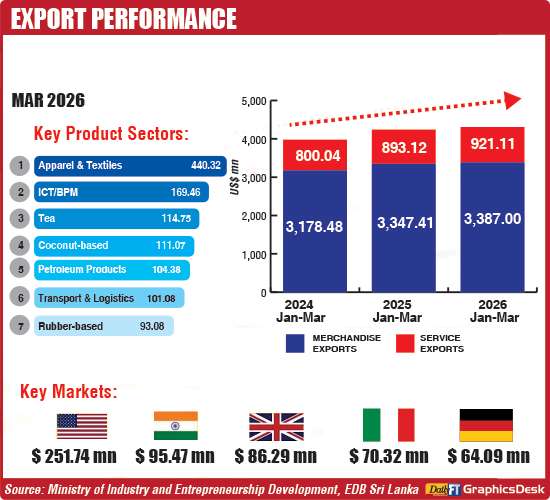
Sri Lanka’s total export earnings rose 1.6% year-on-year to over $4.3 billion in the first quarter of 2026, the Export Development Board (EDB) said, even as the closure of the Strait of Hormuz drove a sharp March drop.
Merchandise exports for the quarter rose 1.2% YoY to exceed $3.3 billion, while estimated services exports grew 3.13% YoY to $921.11 million, supported by ICT/BPM, construction, financial services and logistics.
The quarter’s resilience masked a sharp month of March. Total exports for the month fell 5.2% YoY to $1.46 billion, with merchandise down 4.94% to $1.18 billion and services down 6.26% to $286.92 million. On a month-on-month basis, March exports were down 10.63% from February. The EDB cited the closure of the Strait of Hormuz as a key factor, with shipping delays, cargo rerouting and some consignments discharged midway.
EDB Chairman and CEO Mangala Wijesinghe told reporters the first quarter was “a resilient way towards achieving the country’s annual export targets.” He attributed the March slump to higher shipping and insurance costs, logistical constraints and operational expenses tied to the Middle East war.
Among growth segments, electrical and electronic components rose 44.18% to $142.02 million, food and beverages 26.05% to $174.5 million, coconut products 20.85% to $314.09 million, seafood 30.93% to $63.16 million and ICT/BPM 31.15% to $468.72 million. Apparel and textiles, the dominant export, contracted 8.06% to $1.27 billion as US demand fell 6.37% and EU demand 7.28%. Tea earnings slipped 5.22% to $351.58 million and spices 5.38% to $112.63 million.
Exports to the United Arab Emirates contracted 72.6% YoY in March, the EDB said, attributing the collapse to “geopolitical tensions between the US and the Gulf region.” India consolidated its position as Sri Lanka’s second-largest market, surpassing the UK, with January–March shipments up 12.02% to $287.49 million.
Sri Lanka has set a $20 billion export revenue target for 2026, implying 10–12% YoY growth, and a longer-term goal of $36 billion by 2030.