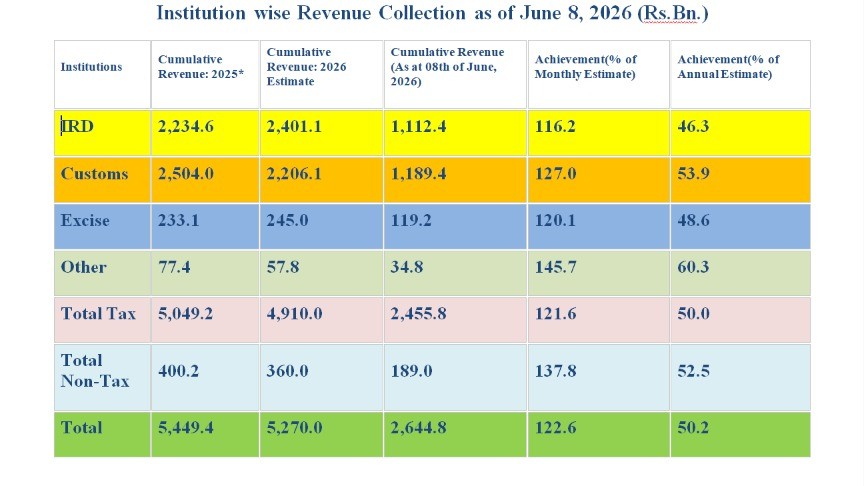
Sri Lanka’s government revenue collection by all three major tax-collecting agencies has outperformed up to June 8, expanding more than 50 percent year-on-year, Finance Ministry data obtained by EconomyNext showed.
The country has already achieved 50 percent of its full-year revenue goal by June 8, with the government targeting Rs.4,910 billion in tax revenue for 2026 — 2.8 percent below 2025’s record Rs.5,449.4 billion.
The Inland Revenue Department outperformed its period target by 46.3 percent to collect Rs.1,112.4 billion as of June 8, while Sri Lanka Customs gathered Rs.1,189.4 billion, a 53.9 percent jump from the same period last year. The Excise Department also exceeded its year-to-date revenue benchmark by 48.6 percent.
“Usually, the revenue is higher in the second half compared to the first half,” Deputy Economic Minister Nishantha Jayaweera told EconomyNext on Wednesday after a media briefing in Colombo, signalling further upside as the year progresses.
The surge stems from an aggressive, enforcement-led modernisation of the state’s fiscal apparatus under International Monetary Fund structural benchmarks. The IRD has shifted from a passive auditing posture to a proactive enforcement regime, with mandatory Taxpayer Identification Numbers now legally required for opening bank accounts, registering vehicles or land, and applying for credit cards.
The Inland Revenue (Amendment) Act expanded withholding tax mandates to 29 new independent service professional categories, while a significantly lowered Value Added Tax registration threshold has pulled more businesses into the formal net. The government has paired these structural expansions with severe penalties for non-compliance and limited relief incentives to boost voluntary compliance.
The mid-year milestone follows Sri Lanka Customs beating its May target by 16 percent to take five-month receipts past Rs.1.14 trillion and the IRD crossing Rs.1 trillion in collections by May 18. The fiscal momentum supports President Anura Kumara Dissanayake’s IRD reform push and the Revenue Management Committee’s medium-term goal of lifting revenue to 20 percent of GDP.
Source: EconomyNext.