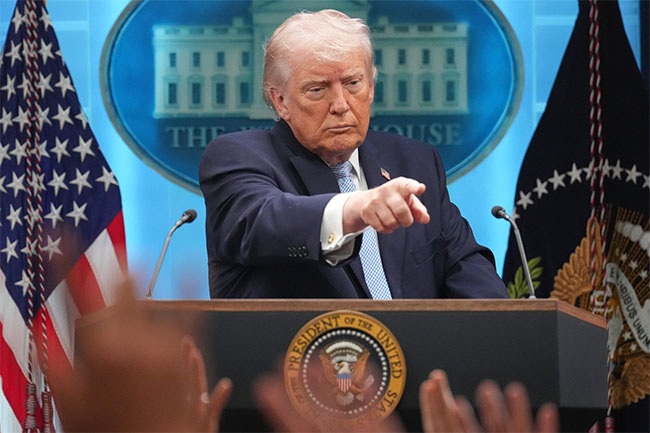
US President Donald Trump declared on Wednesday that Iran has undergone what he called a “very productive Regime Change,” sharply expanding the publicly stated terms of the two-week ceasefire announced hours earlier.
In a post on his Truth Social platform, Trump said Washington would permit no uranium enrichment on Iranian soil and would work with Tehran to “dig up and remove all of the deeply buried (B-2 Bombers) Nuclear ‘Dust.’” The president described the framework as one of cooperation rather than confrontation, saying: “The United States will work closely with Iran, which we have determined has gone through what will be a very productive Regime Change.”
Trump claimed US surveillance capabilities had been tracking Iran’s nuclear material throughout the six-week war. “It is now, and has been, under very exacting Satellite Surveillance (Space Force!). Nothing has been touched from the date of attack,” he wrote, according to Ada Derana’s report citing Turkiye Today.
The statement went further on economics as well. “We are, and will be, talking Tariff and Sanctions relief with Iran. Many of the 15 points have already been agreed to,” Trump added. He did not specify which elements of the reported 15-point plan had been accepted by Tehran, and Iran has not publicly used the language of “regime change” or conceded a full halt to enrichment.
Iranian officials have so far framed the Pakistan-brokered truce very differently. The country’s UN ambassador in Geneva said Wednesday that Tehran was entering Islamabad talks with “zero trust” and had only agreed to a limited, conditional reopening of the Strait of Hormuz. A separate Iranian source has already warned that Tehran could withdraw from the agreement if Israel continues its strikes on Lebanon.
For Sri Lanka, the medium-term outlook turns heavily on whether the Trump framing holds. A durable US–Iran settlement with permanent Hormuz access would ease pressure on Colombo’s fuel pipeline and on global oil prices that have already swung sharply on ceasefire news this week.