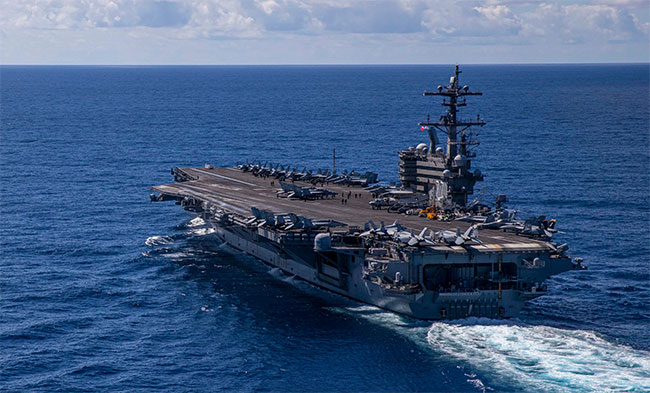
A third United States aircraft carrier, the USS George HW Bush, has arrived in the Middle East, joining the USS Gerald R Ford and the USS Abraham Lincoln in a deployment that defence analysts are calling “highly unusual.”
US Central Command confirmed the strike group was sailing in the Indian Ocean as of April 23. The Bush is accompanied by three Arleigh Burke-class destroyers — the USS Ross, USS Donald Cook and USS Mason — and carries nearly 5,000 sailors and nine aircraft squadrons.
Before the Bush’s arrival, at least 21 US Navy warships and more than 16,500 sailors and marines were already operating in the region, according to data from the United States Naval Institute. Roughly 40 per cent of US naval capacity is now concentrated in the Middle East theatre.
“Moving from one to three carriers does not simply increase presence — it fundamentally transforms operational capacity by enabling continuous multi-axis air operations,” defence industry site Army Recognition said in an analysis cited by Ada Derana.
The USS Gerald R Ford, the world’s largest aircraft carrier, is operating in the Red Sea after repairs in Croatia. It has now set the record for the longest US aircraft carrier deployment since the Vietnam War, surpassing 300 days at sea.
Most of the warships in the region are tasked with enforcing President Donald Trump’s blockade of Iranian ports, imposed on April 13. Iran has maintained its own counter-blockade of the Strait of Hormuz for nearly two months, sending global energy prices soaring. Roughly one-fifth of world oil and LNG exports normally pass through the waterway.
Admiral Daryl Caudle, chief of naval operations, said the third carrier would help support safe passage for tankers and respond to Iranian sea mines and other asymmetric threats. Mr Trump has ordered the navy to “shoot and kill any boat” laying mines.
The Bush’s arrival follows the US seizure of the Majestic X tanker in the Indian Ocean and an Iranian attack on three cargo ships in the strait, with two captured.