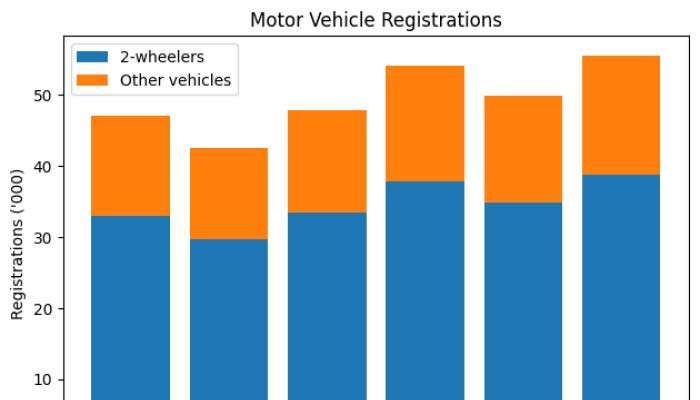
Sri Lanka’s vehicle registrations climbed 11.1% month-on-month to an all-time monthly record of 55,470 units in March, driven by a broad-based pick-up across segments and a front-loaded buying rush ahead of new tax measures, according to HNB Stockbrokers.
Two-wheeler registrations rose 15.7% to 38,977 units, while brand-new car and sport utility vehicle (SUV) registrations jumped 32.2%, reflecting a sharp rebound in passenger vehicle demand. HNB Stockbrokers said importers appeared to have accelerated purchases ahead of the Social Security Contribution Levy (SSCL), which takes effect in April 2026.
“The implementation of the SSCL from April 2026, alongside increased rupee volatility, is likely to moderate momentum for the rest of the year as pent-up demand is fully absorbed,” the broker said.
Motor car registrations reached 4,465 units in March, of which 1,277 or 28.6% were brand new — a 177% jump from February that reversed a 6.1% decline. SUV registrations totalled 5,051, including 2,186 brand-new units. Commercial vehicle registrations climbed to 2,698, of which 1,744 were brand new, delivering year-to-date growth of 60.1%.
Electric vehicles dominated new car registrations, accounting for 83.1% of the segment. Chinese carmaker BYD led with 785 units, driven largely by the BYD Atto 1 priced at Rs. 8 million to Rs. 9 million. Toyota registrations doubled to 126 units, while BAW’s E7, priced between Rs. 5 million and Rs. 6 million, remained a strong contender in the lower end of the market.
In the SUV segment, internal combustion engine vehicles still accounted for 76.3% of brand-new registrations, reflecting the limited availability of competitively priced electric alternatives. Suzuki and Nissan together held around 47.8% of the SUV market, led by the Fronx and Magnite models in the Rs. 9 million to Rs. 10.5 million bracket. Plug-in hybrids, including BYD’s Sealion range, gained traction at higher price points.
The March record comes as the Department of Motor Traffic continues to struggle with processing delays that stretched one-day registration services to six or seven working days after imports reopened in February 2025.