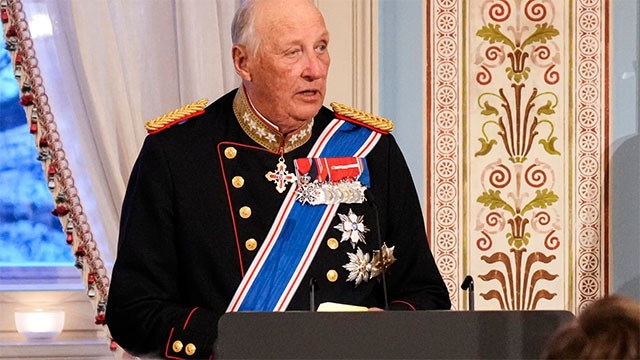
King Harald V of Norway, Europe’s oldest monarch, died in Oslo early on Friday at the age of 89. His son Haakon, 53, automatically succeeded him as King Haakon VIII.
The palace said Harald died peacefully at 06:35 local time (04:35 GMT). Al Jazeera reported he had been in hospital since 17 August with haemolytic anaemia, a rare condition in which red blood cells are destroyed faster than the body can replace them. Outlets described the hospital differently — Deutsche Welle copy carried by NewsFirst and Al Jazeera both named Oslo University Hospital, while the Associated Press report run by Ada Derana and the BBC copy carried by the Daily Mirror called it the national hospital in Oslo.
His condition worsened over his final days, and Queen Sonja and Prince Haakon cancelled their engagements to be at his bedside. The royal flag over the palace was lowered to half-mast. Haakon was to hold an extraordinary council of state with the government later on Friday.
A reign of 35 years
Harald came to the throne after his father, King Olav V, died on 17 January 1991, taking the oath days later on 21 January. He reigned for 35 years in a role that is largely ceremonial, with power in the country of 5.5 million resting with an elected parliament.
“A whole nation is in mourning and the people of Norway are left with a deep sense of gratitude for a long life in the service of Norway,” Prime Minister Jonas Gahr Støre said. “For more than three decades as monarch, Harald V demonstrated an unwavering faith in the Norwegian people.”
Unlike his second cousin Queen Margrethe of Denmark, who abdicated in 2024, Harald refused to step down despite repeated hospital stays, saying the oath he swore “lasts for life”.
Exile, and a nine-year wait
Born on 21 February 1937 near Oslo, Harald was the first Norwegian prince born in the country since the 14th century. He was three when Nazi Germany invaded. His mother fled with him and his two sisters to Sweden and then to the United States at President Franklin D. Roosevelt’s invitation, while his father and grandfather went into exile in Britain with the government. The family was reunited in Norway in June 1945.
As a young man he was urged to marry a European princess. He waited nine years for his father’s consent to marry his school sweetheart Sonja Haraldsen, a businessman’s daughter, telling Olav he would otherwise stay single. They wed on 29 August 1968 — he died a day short of their 58th anniversary.
Harald was widely praised for his response to the July 2011 attacks in which Anders Behring Breivik killed 77 people, eight in an Oslo car bombing and 69 more, mostly teenagers, on the island of Utøya. “I remain convinced that the belief in freedom is stronger than fear,” he said. In 2016 he gave an unexpected speech backing LGBTQ+ equality, refugees and religious tolerance, saying “Norwegians are girls who love girls, boys who love boys, and girls and boys who love each other.”
The family faced difficulties late in his reign. His daughter-in-law, Crown Princess Mette-Marit, came under scrutiny in early 2026 over contacts with the late sex offender Jeffrey Epstein; she is not accused of wrongdoing and apologised. Her son from an earlier relationship, Marius Borg Høiby, who holds no royal title, was convicted of rape and jailed for four years.
He is survived by Queen Sonja, his daughter Princess Märtha Louise, the new king and six grandchildren.
Norway maintains active development and maritime ties with Sri Lanka. It has offered Colombo free satellite vessel-tracking under a Blue Justice fisheries agreement to combat illegal fishing, and funded the digital compensation platform built for Cyclone Ditwah survivors.
Sources
- Norway’s King Harald V dies at 89 and his son becomes King Haakon VIII — Ada Derana / AP, August 28
- King Harald V of Norway, Europe’s oldest monarch, dies after 35 years on the throne — NewsFirst / DW, August 28
- Norway’s King Harald dies aged 89 — Daily Mirror / BBC, August 28
- King Harald V of Norway passes away — Hiru News, August 28
- Norway’s King Harald V dies, succeeded by son — Al Jazeera, August 28