Nepal’s National Disaster Risk Reduction and Management Authority has reported an increase in flood levels near the Bhote Koshi River and told communities along its banks to stay alert, four days after the same river carried a wall of water and debris through the country’s north.
The Bhote Koshi was one of two rivers down which the torrent travelled on Wednesday, sweeping past tourist and pilgrimage towns in northern Nepal. Ada Derana reported the warning on Sunday morning. The authority did not say what is driving the rise, how high the water has come, or which settlements are at risk.
The toll has moved again
The death toll in Nepal has risen to 675, the disaster authority said on Saturday — up from the 626 reported by Nepal police earlier the same day. China’s Sunday update has since raised the Tibet toll from seven to 16, taking the regional total to 691 — see the update below.
The number of people missing in Nepal stood at 2,426 after Saturday morning’s sharp increase, and has since been revised to 2,498. That list includes 517 foreigners and 933 workers on hydropower projects along the affected river. It also includes 45 Nepali Army soldiers, 40 police officers and 19 immigration and customs officers — a detail that has not appeared in earlier counts and indicates how many of the missing were on duty when the water arrived.
Seven bodies recovered from rivers in India are still excluded from the Nepali toll.
Identification has become the bottleneck
The figures being published are not converging, and the reason is now visible. The Kathmandu Post reported on Sunday that only 20 of 669 recovered bodies had been identified by relatives as of Saturday evening, and that 211 of them were found as mutilated, partial or severed remains. Nepal Police spokesperson Deputy Inspector General Abi Narayan Kafle said many had been buried under mud and water for two to three days.
Bodies have been carried dozens of kilometres downstream — as far as Rupandehi, Chitwan and Pokhara — and mortuaries across the Narayani river basin have reached capacity. Nawalparasi East has moved 41 bodies to Pokhara and eight to Palpa.
The government has issued an emergency directive allowing district authorities to bury unidentified remains once storage runs out, after recording DNA, thumbprints, dental records and photographs against a permanent tracking number for each body. In Chitwan, where 233 bodies have been recovered and four identified, a burial site has been selected at Devghat.
The two numbers in circulation are not measuring the same thing. The 675 comes from the disaster authority and counts people killed; the 669 the Kathmandu Post attributes to police counts bodies actually recovered. A body recovered is not yet a death confirmed, and a death confirmed is not always a body recovered, so the six-figure gap is a stage-of-counting difference rather than either agency being wrong. Sri Lanka’s newsrooms have carried the disaster authority’s number.
Context
Nepal has put the cost of rebuilding at $4-5 billion, close to a tenth of its economy. Sri Lanka has extended $1 million in humanitarian assistance and is now preparing to send relief teams.
No other verified newsroom had filed the Bhote Koshi flood-level warning at the time of writing.
Update: China revises its toll, regional total reaches 691
China issued a fresh update on Sunday raising the number of dead in Tibet from seven to 16 and revising its missing down from 558 to 546, Hiru News reported. With Nepal’s disaster authority at 675 dead and 2,498 missing, the combined figure across the two sides of the border is 691 dead and more than 3,000 unaccounted for, on the fourth day of the search.
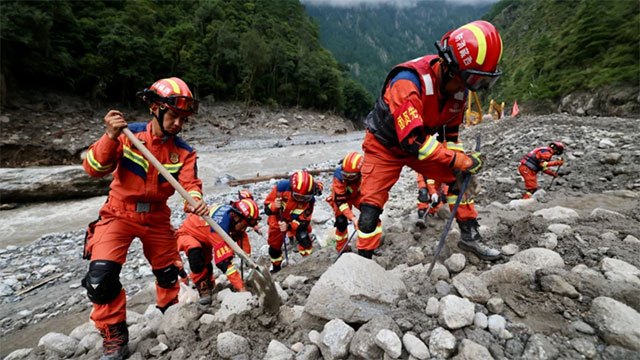
More than 3,700 people have been rescued in Nepal. The government says over 100 hydropower workers may still be alive inside tunnels, and that rescue work is running at several sites rather than one — Energy Minister Biraj Bhakta Shrestha said “rescue efforts are going on in multiple tunnel sites,” correcting earlier reports that placed all of the trapped in a single location. Rescuers broke through the mud at Trishuli 3A on Saturday and began pumping air into the tunnel; a camera is being sent in. Brigadier General Raja Ram Basnet said teams were contending with four to five feet of mud and few places to land a helicopter.
Indian and Chinese tunnel-rescue specialists have joined the effort, India bringing “rat-hole” miners experienced in Himalayan tunnel collapses. A Nepali Army official said its helicopters were managing about 500 trips a day into the disaster zone. Poor weather and terrain have repeatedly interrupted flying.
The United States announced more than USD 3.6 million in humanitarian aid on Saturday, including three months of emergency food assistance for up to 10,000 households.
The wider regional response — India’s glacier monitoring, a Nepal-China data-sharing agreement and a warning from the UN climate chief is covered separately.
Sources
- Nepal’s disaster response agency warns of flood level increase — Ada Derana, August 30
- Nepal flood death toll rises to 675 — Ada Derana, August 29
- 20 identified out of 669 flood victims as Nepal prepares mass burials — The Kathmandu Post, August 30
- Nepal flood death toll nears 700 — Hiru News, August 30