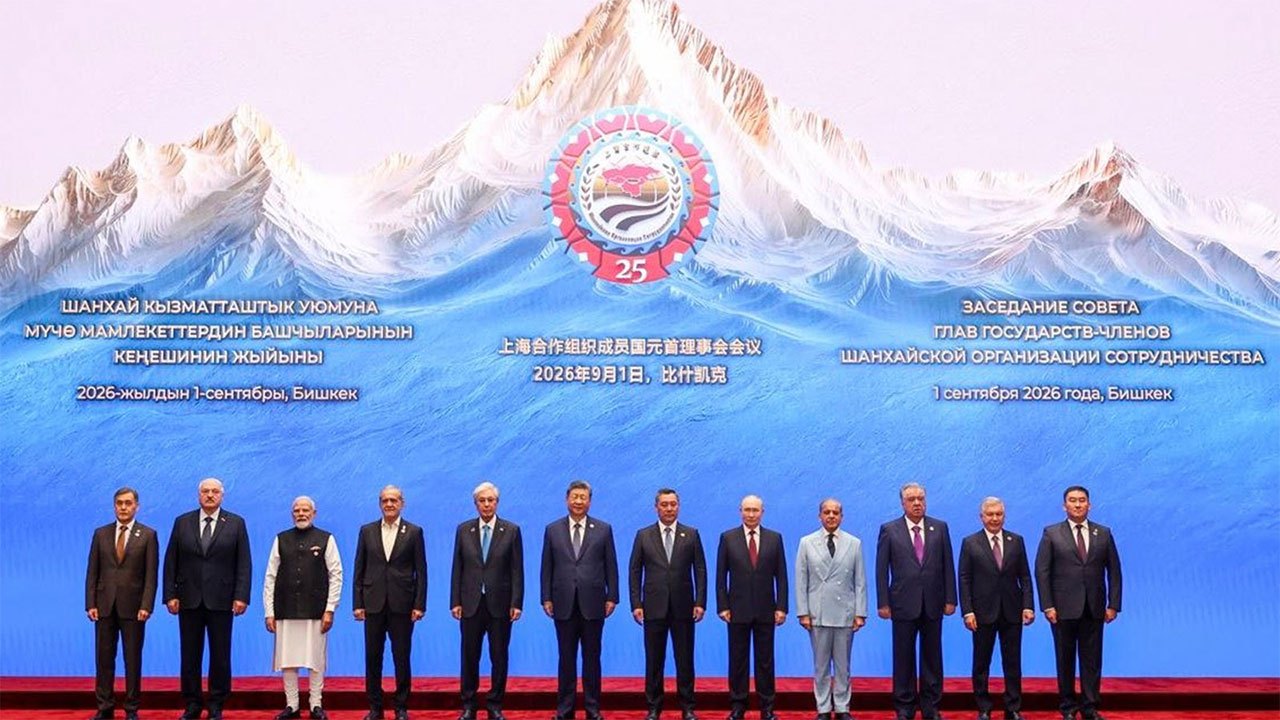
Leaders of the Shanghai Cooperation Organisation signed the Bishkek Declaration on Tuesday at the close of the bloc’s 26th summit in the Kyrgyz capital, committing its ten members to a common position condemning the US-Israeli war on Iran and opposing Western sanctions.
The declaration was signed by Chinese President Xi Jinping, Russian President Vladimir Putin, Indian Prime Minister Narendra Modi and Pakistani Prime Minister Shehbaz Sharif, among other heads of state, Hiru News reported. The SCO groups Russia, China, India, Pakistan, Iran, Belarus, Uzbekistan, Kazakhstan, Tajikistan and the Kyrgyz Republic. The summit also marked the organisation’s 25th anniversary.
The Iran clauses
The bloc condemned “military strikes on the territory of the Islamic Republic of Iran, which have resulted in numerous civilian casualties and significant damage to the country’s economy,” saying the attacks “violate the principles and norms of international law and the UN Charter and create serious risks to international peace, security and stability.”
Members offered condolences on “the tragic death of Supreme Leader Seyyed Ali Khamenei” — who was buried after a three-day state funeral in Mashhad in June — and reaffirmed support for Iran’s sovereignty and territorial integrity, urging a settlement “solely through political and diplomatic means.”
The declaration also backed Iran’s rights under the Nuclear Non-Proliferation Treaty, with members asserting an “inalienable right” to develop and use atomic energy for peaceful purposes and stating that measures restricting that right are “contrary to international law.” That language goes directly to the dispute at the centre of the war: Washington has demanded Iran surrender domestic uranium enrichment entirely, a demand Tehran has rejected as incompatible with its NPT rights. Iran is itself an SCO member.
Without naming the United States, members said they opposed “unilateral coercive measures” contrary to UN and World Trade Organization rules. The declaration separately said Israel’s attacks on Palestine had destabilised West Asia and that a “comprehensive and just settlement of the Palestinian question” was the only route to regional stability.
India and Pakistan split in the open
The two neighbours restated their competing positions on terrorism from the same platform. Modi called terrorism “a grave challenge to all of humanity” and urged an end to “double standards.”
“We must dismantle the entire ecosystem of terrorist financing, recruitment, radicalisation, and safe havens. We must speak with one voice and make it clear that there can be no place for double standards on this serious issue.”
Modi added that countries using terrorism “as an instrument of policy” must be told it “can never be a strategic asset for anyone.” Observers read the remarks as directed at Pakistan, Hiru said. Sharif responded by casting his country as a victim, saying he had recalled “Pakistan’s immense sacrifices in the fight against terrorism.”
Despite the exchange, both signed declaration text condemning terrorism “in all its forms” and calling double standards in fighting it “unacceptable.”
The economic and procedural package
Ada Derana, working from a different wire, reported the document package rather than the Iran language: a protocol amending the SCO charter of 7 June 2002, regulations for a Universal Centre for Countering Security Challenges and Threats, and regulations for the executive committee of the SCO Anti-Narcotics Centre.
Leaders also adopted cooperation programmes on combating drug addiction and the spread of synthetic drugs and their precursors, both running to 2030; a plan on international information security for 2026–2028; a biodiversity initiative for 2026–2031; a “Green Technology Corridor” scientific and technological programme for 2026–2030; and a roadmap for developing member states’ ports and logistics centres for 2026–2030.
On trade, members pledged to support “an open, transparent, fair, inclusive, and non-discriminatory multilateral trading system” with “special and differential treatment for developing countries,” and to implement the SCO Economic Development Strategy and the Energy Cooperation Strategy, both to 2030. Hiru linked the energy discussion directly to the war’s effect on shipping through the Strait of Hormuz.
Why it matters to Colombo
Sri Lanka holds dialogue partner status at the SCO, one step below full membership, which requires unanimous approval from existing members. In May, Foreign Minister Vijitha Herath told SCO Secretary-General Nurlan Yermekbayev in Colombo that Sri Lanka wanted deeper engagement across tourism, transport, logistics and agriculture, and pitched the Colombo Port City and free trade zones for investment. Yermekbayev also delivered a lecture at the Lakshman Kadirgamar Institute later that month.
That outreach was explicitly staged ahead of the bloc’s annual heads-of-state meeting — the summit that has now taken place. The ports and logistics roadmap adopted in Bishkek covers the sector Herath named.
The Iran clauses also bear on Sri Lanka more concretely than most summit language. The war has driven the oil price shocks feeding into local fuel pricing, and has left sanctioned Iranian tankers anchored off Galle inside waters the government says it is monitoring.
Two wires, two summits
The divergence between the outlets is worth noting. Ada Derana carried an IANS report built around Modi’s terrorism address and the signed instruments, and did not mention Iran, Khamenei or Palestine at all. Hiru carried an Al Jazeera report built around the Iran, sanctions and Palestine clauses, and did not list the procedural documents. Neither account is a superset of the other, and readers of either alone would take away a materially different summit.
Neither outlet reported whether dialogue partners such as Sri Lanka attended, what Iran’s own delegation said, or when and where the 27th summit will be held.