The World Health Organization has presented Sri Lanka with a citation recognising ten unbroken years free of both malaria and maternal and neonatal tetanus, NewsFirst reported.
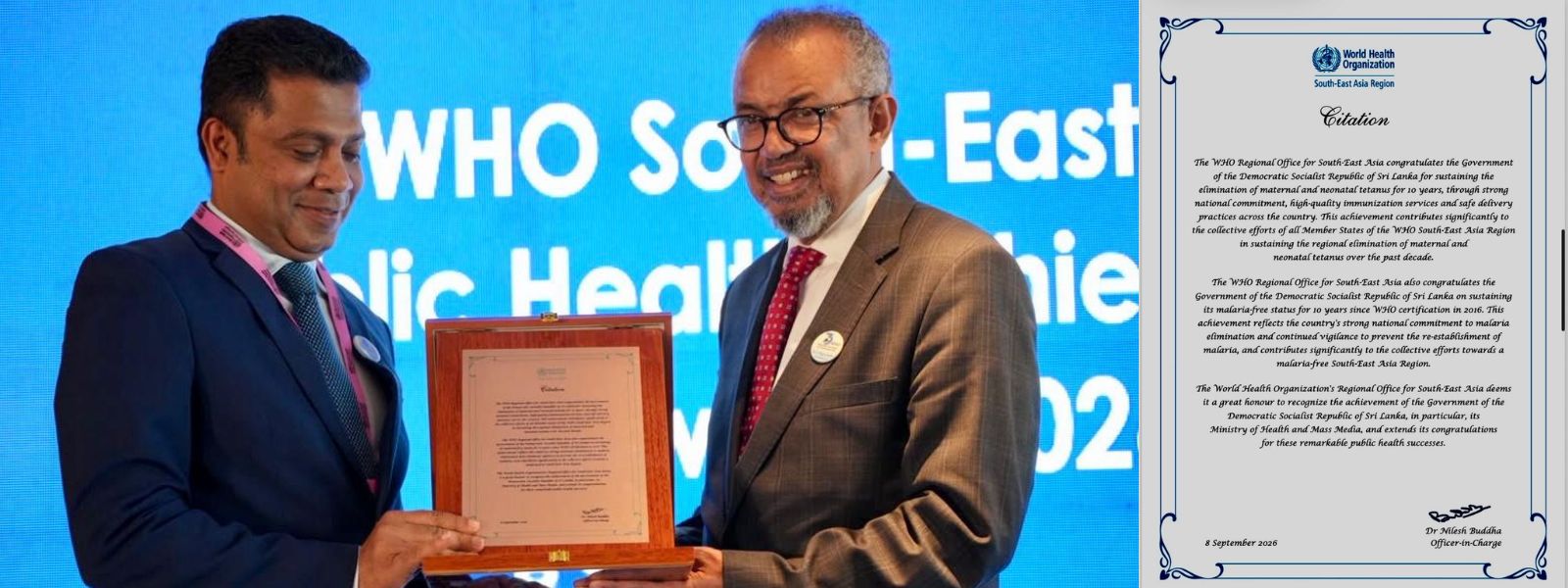
The citation was handed over at the 79th session of the WHO Regional Committee for South-East Asia in Dili, Timor-Leste. It was signed by Dr. Nilesh Buddha, Officer-in-Charge of the WHO Regional Office for South-East Asia, and presented to Health and Mass Media Minister Dr. Nalinda Jayatissa by WHO Director-General Dr. Tedros Adhanom Ghebreyesus.
What the citation covers
On tetanus, the regional office congratulated the government for sustaining the elimination of maternal and neonatal tetanus across the decade through national commitment, high-quality immunisation services and safe delivery practices. Sri Lanka continues to run a nationwide tetanus toxoid immunisation programme for pregnant mothers, part of an immunisation system now four decades old.
On malaria, the citation records that Sri Lanka has held its malaria-free status since WHO certification in 2016, and credits continued vigilance against re-establishment of the disease. It frames that as a contribution to the regional goal of a malaria-free South-East Asia.
Sri Lanka was the second country in the region to eliminate malaria, after the Maldives. The WHO attributes both achievements to the country’s primary healthcare system, sustained national commitment, immunisation coverage, and disease surveillance and control — the same public health infrastructure that marked its centenary in July.
The regional office called it a “great honour” to recognise the achievements of the Government of Sri Lanka.
Preventing re-establishment is the harder half
Certification is a statement about the past; holding it is the recurring task. Malaria elimination is reversible — imported cases arriving with travellers can re-seed transmission wherever the mosquito vector persists, which is why the citation’s language dwells on vigilance rather than victory.
The recognition also lands against a mixed domestic picture. The same ministry is managing a dengue year that has passed 96,000 cases and 73 deaths, with the control unit warning the risk has not passed — a reminder that success against one vector-borne disease does not transfer to another.
This answers a gap we flagged
When the Dili session opened, LankaNewz noted that no report covered Tedros, who had been expected to attend, or any concrete outcome for Sri Lanka beyond the minister’s address. He was there, and the citation is the first Sri Lankan deliverable to come out of the session.
Not reported
NewsFirst did not say on which day of the four-day session the citation was presented, whether other member states received similar recognitions, or whether the Dili Declaration on equitable access to specialised care — the session’s principal deliverable — has been adopted. It did not give the year maternal and neonatal tetanus elimination was validated, so the ten-year count cannot be checked against a start date, and it did not report the outcome of the election of new office-bearers, which determines whether Jayatissa has handed on the chair.
Update, September 9 evening: Daily Mirror corroborates
The Daily Mirror carried the citation later on Wednesday evening, reporting the same award independently. Its account matches NewsFirst’s on every checkable particular: Tedros presenting to Jayatissa, the signature of Dr. Nilesh Buddha, the 79th Regional Committee session, certification as malaria-free in 2016, and Sri Lanka as the second country in the region after the Maldives to eliminate malaria.
Two points are worth drawing out. The Daily Mirror describes the Dili session as “currently being held”, which places the presentation inside the session rather than at its close — though it too does not name the day. And it carries a closing WHO remark the earlier report did not: that the achievements go beyond health milestones, contributing to “the protection of the lives of the Sri Lankan people and supporting the creation of a healthier future for generations to come.”
This report was originally published as single-source, with Ada Derana unreachable behind a server-side block across the whole domain. That block persisted through the evening, but the story is no longer resting on one newsroom.