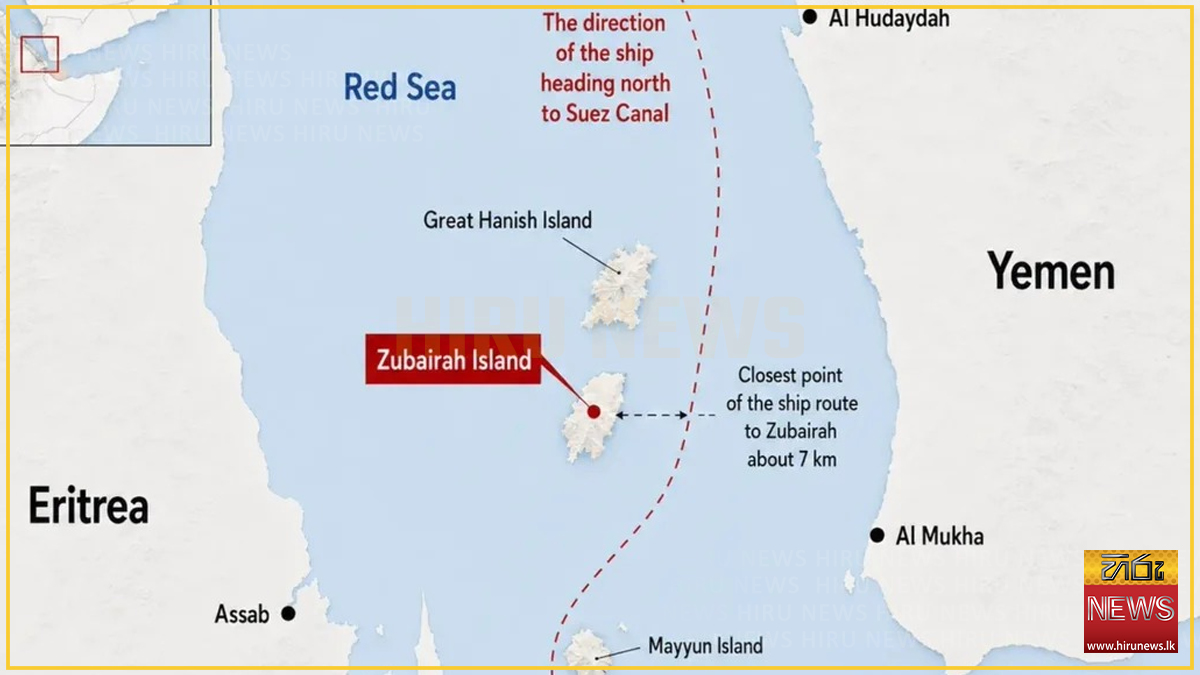
Yemen’s Iran-aligned Houthi forces seized the Red Sea port city of Mocha on Thursday, tightening their position around the Bab al-Mandeb strait — one of the world’s principal routes for crude oil and fuel moving from the Gulf to the Mediterranean via the Suez Canal.
Mocha lies roughly 60 km from the strait, Al Jazeera reported. Witnesses described Houthi fighters entering the city chanting slogans against the United States and Israel, according to Hiru News.
Why this matters for shipping — and for Sri Lanka
Bab al-Mandeb is the southern outlet of the Red Sea, between Yemen and the African coast. With Iran having blocked the Strait of Hormuz as leverage in its war against the United States, pressure on Bab al-Mandeb puts Iran-aligned forces close to commanding chokepoints at both ends of the Arabian peninsula.
For Sri Lanka the exposure is direct rather than distant. Disruption on this route lengthens voyages around the Cape, raises freight and insurance costs on the Colombo–Europe trade, and feeds into fuel import costs — the mechanism behind the Brent crossing US$100 and the successive pressure already recorded on local markets.
The islands claim differs between outlets
Hiru News reports that the Houthis also captured the southern Red Sea island of Zuqar, following rocket attacks and an amphibious assault using troop-transport boats.
Al Jazeera’s report makes no mention of Zuqar or the Hanish islands. Reuters wire copy carried locally describes the Houthis as launching attacks on the Hanish islands — of which Jabal Zuqar is part — rather than having taken them, and reports government forces relocating south to Dhubab, on the strait opposite the island of Perim.
Whether Zuqar has fallen or is still contested is therefore unresolved in the reporting, and the two accounts should not be merged.
Casualty figures also diverge
Hiru News, citing data compiled from several sources, reports more than 500 killed since last week, mostly combatants, and says the International Organization for Migration puts displacement at nearly 20,000 people.
Al Jazeera reports at least 194 killed and 880 wounded over the past two weeks across the various fronts. The two figures cover different periods and cannot be reconciled from the reports; the gap is large enough that neither should be presented as settled.
The Royal United Services Institute, a London defence think tank, is quoted by Hiru News saying the situation in Yemen is spiralling out of control.
A UN-brokered truce in 2022 largely halted years of war but produced no lasting settlement. The current fighting is the most serious escalation between the Houthis and the internationally recognised government in years.
Update: the full Reuters wire narrows the blockade — and it is aimed at Saudi Arabia
Reuters copy carried in full by the Daily Mirror answers the central question this article left open: shipping has not been closed to everyone.
The Houthi-run humanitarian operations coordination centre said in a statement that Red Sea navigation is safe for all shipping companies except for Saudi vessels. Houthi spokesperson Mohammed Abdulsalam said the operations were defensive and would stop once attacks on Yemen stopped.
That is a targeted blockade rather than a closure of the route, and it follows the naval blockade the Houthis declared against Saudi Arabia in July. They entered the current war alongside Iran with an attack on Israel in March, stayed largely quiet, and stepped up strikes on the south of the kingdom this month.
Why Saudi Arabia specifically is exposed: with the Strait of Hormuz effectively closed by the war, the world’s largest oil exporter has been relying on the Red Sea route. A blockade at Bab al-Mandeb closes the alternative.
Markets moved on it. Brent crude jumped as much as 4% on Thursday to US$105 a barrel on concern over supply routes.
Reuters also reports the Hormuz corridor tightening again: just seven vessels transited the strait on Wednesday, half the ten-day average, according to preliminary ship-tracking data — reversing what Washington had described as gradual progress in guiding tankers through.
On the islands, Reuters is more specific but still does not say “Zuqar”
The full wire says the Houthis “advanced down the Red Sea coast to strategic islands” and had reached the islands of Hanish — of which Jabal Zuqar is part. That is firmer than an attack but still short of Hiru News’s claim that Zuqar itself has been captured, and Al Jazeera still does not mention the islands at all. The discrepancy narrows; it does not close.
Reuters confirms the government’s southward movement to Dhubab, opposite Perim, and quotes military sources saying control of the town and the island is key to holding the strait.
Diplomacy: a Saudi warning relayed through Pakistan
Pakistan delivered a Saudi warning to Iran on Tuesday urging it to rein in the Houthis, according to Saudi, Pakistani and Iranian sources. A senior Iranian official confirmed the message was passed on and said Tehran’s response was that “Iran does not control the Houthis.”
Saudi civil defence authorities issued emergency alerts in the south-western city of Khamis Mushait for the fourth time in 24 hours on Thursday as Houthi attacks continued.
Separately, President Donald Trump said on Wednesday he expected the war with Iran to end immediately after November’s US midterm elections — a statement he repeated at the Republican convention, and one that sets the horizon for the oil prices Sri Lanka is paying.
Still not reported
No outlet states what Bab al-Mandeb’s current daily transit volume is, whether any shipping line has changed routing in response, or how the Houthis would distinguish Saudi-linked vessels in practice. None reports a US, Saudi or UN response to the fall of Mocha itself, and none gives casualty figures that reconcile with each other.