Sri Lanka’s headline unemployment rate of 3.9 per cent for 2025 conceals a labour market in which fewer than half of working-age adults are counted as participating at all, according to an analysis of Department of Census and Statistics data published by Hiru News.
The unemployment rate counts only people actively seeking work. It says nothing about the far larger group who have stopped looking.
The number under the number
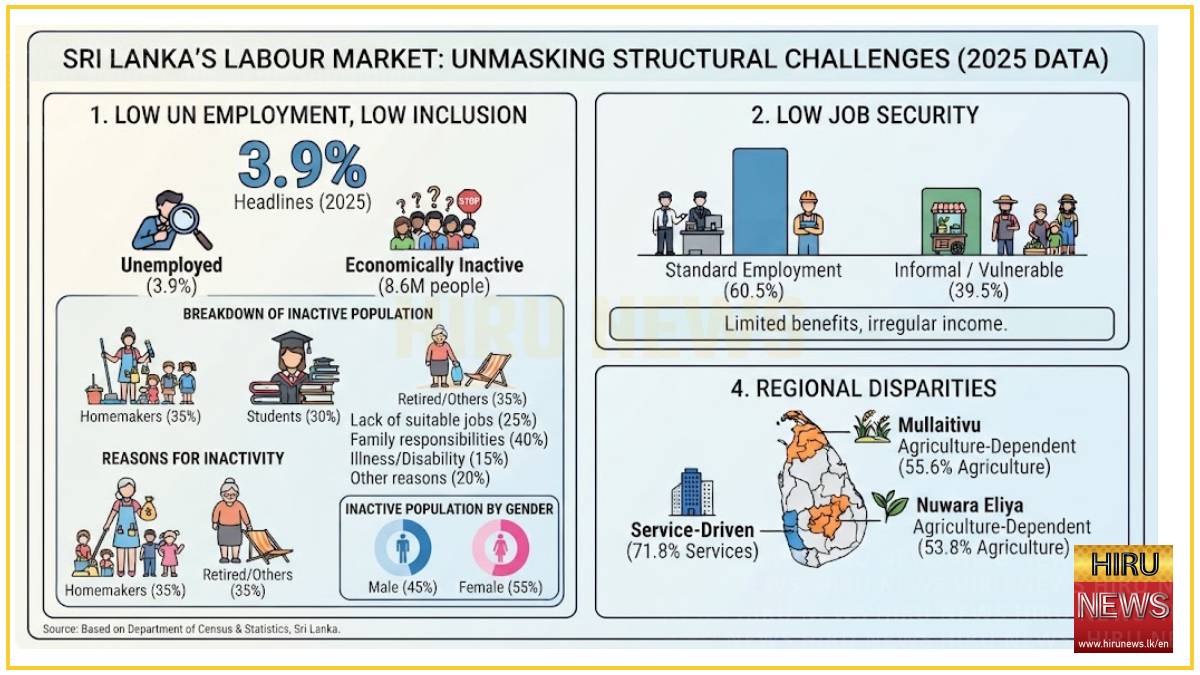
The national labour force participation rate stands at 49.4 per cent. Of a working-age population of more than 17 million, roughly 8.6 million people are economically inactive.
Set the two figures against each other and the scale becomes clear. A 49.4 per cent participation rate implies a labour force of about 8.4 million; unemployment of 3.9 per cent within it implies roughly 330,000 people unemployed.
That is about one person counted as unemployed for every 26 outside the labour force entirely. The headline rate is measuring a small fraction of the gap between Sri Lanka’s working-age population and its working population.
Job quality, not just job counts
Only 60.5 per cent of the workforce are standard employees. The remaining 39.5 per cent are in informal work, self-employment, or unpaid family labour — categories that register as “employed” in the statistics while carrying no contract, no security and often no recorded income.
Two economies, by district
The regional split in the data is stark:
- Colombo is service-driven, with services accounting for 71.8 per cent of employment
- Mullaitivu remains agricultural at 55.6 per cent
- Nuwara Eliya is close behind at 53.8 per cent
Nationally, the industrial sector is stagnant at 26.2 per cent of employment.
The structural reading
The pattern Hiru draws from the data is an economy shifting toward services and splitting along regional lines without having built a broad industrial base first — services concentrating in the commercial capital while rural districts stay in agriculture, with no manufacturing tier growing in between.
That sequencing matters for policy. A service-led economy that skipped industrialisation tends to produce a narrow band of high-productivity urban jobs alongside a large low-productivity rural and informal sector — which is close to a description of the 60.5 per cent figure above.
Context
The participation figure is the one to watch rather than the unemployment rate. Sri Lanka’s 2024 census recorded an ageing population, which puts downward pressure on participation independently of job availability, and the government has been actively exporting labour under bilateral agreements, most recently a Thai framework covering an initial 10,000 workers.
Not reported
Hiru does not break the 8.6 million inactive down by sex, age or reason for inactivity — the female participation rate, which international comparisons have repeatedly flagged as Sri Lanka’s weakest labour indicator, is not given. It does not state which Census and Statistics release the figures come from or its publication date, does not give the youth unemployment rate, and does not compare the 49.4 per cent participation rate with prior years, so the direction of travel cannot be read from the report. No ministry response is recorded.