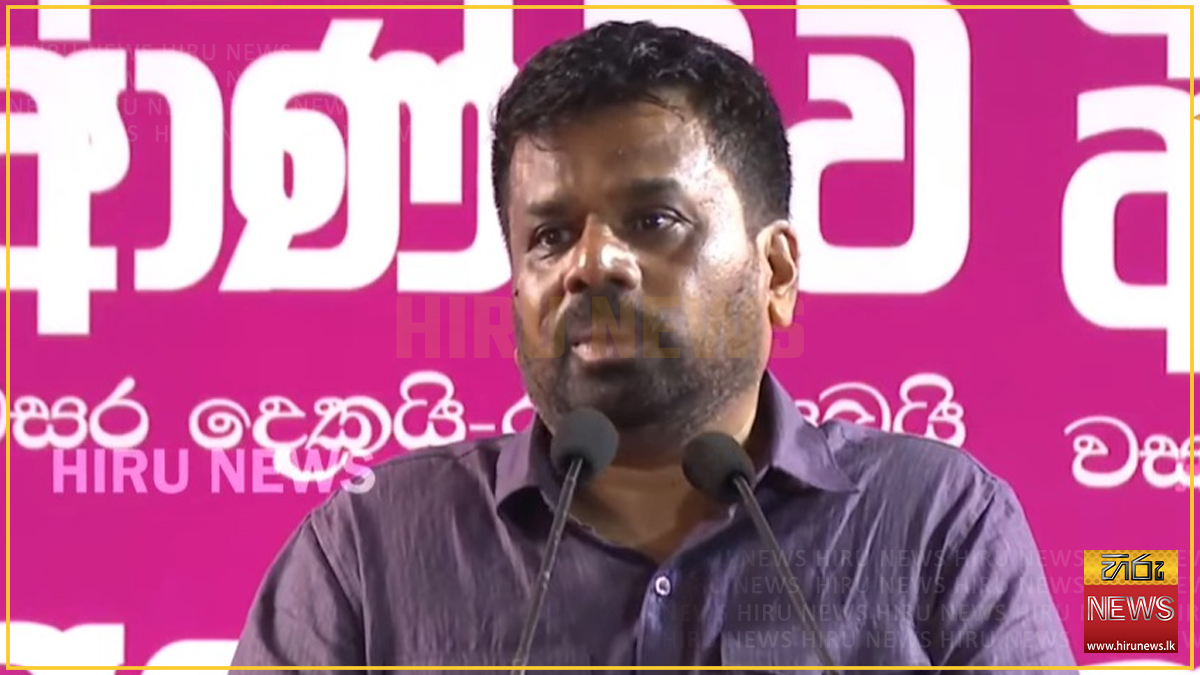
Domestic fuel prices will have to rise from 1 October under the government’s own pricing formula, President Anura Kumara Dissanayake said on Sunday, but the state will step in with a subsidy so that the full increase is not passed to consumers.
Speaking at a public rally in Akuressa, Matara, held under the theme “Two Years of Government — Good for the Country,” the President said imported fuel costs had moved far enough that the formula leaves no alternative.
“According to global market prices, fuel prices need to be increased in October. When we calculate the cost based on imported fuel prices and the pricing formula, prices would have to increase from the first of the month,” he said, the Daily Mirror reported.
He then set out the offset. “When a major burden falls on the people, it cannot simply be passed on to them entirely. The government has to provide some assistance to ease that burden.”
How firm is the subsidy? The outlets differ
The three newsrooms covering the rally do not report the commitment at the same strength.
The Daily Mirror frames it conditionally — the government “expects to provide” a subsidy and “would consider” providing one. Hiru News reports it as settled: the government “will provide a subsidy to control domestic fuel prices” and “will intervene to absorb the price hike.” NewsFirst sits with Hiru, reporting that the President said fuel prices “will continue to be controlled through subsidies, despite the recent rise in global oil prices.”
Two of the three read it as a decision rather than an intention. No outlet reports a subsidy rate, a cost, or which grades it would cover.
The Energy Minister, speaking separately, puts the decision at month-end
Hours earlier in Galle, Energy Minister Anura Karunathilaka said a revision of domestic fuel prices “may be considered at the end of September” in view of the rise in global prices, the Daily Mirror reported separately.
The two timelines are not in conflict — they describe the same boundary from either side. A decision taken at the end of September is what produces a price effective 1 October.
The Minister added a note the President did not: the government is “currently discussing whether the public could bear a further increase,” given that Sri Lankan fuel prices are already at a relatively high level.
The Minister has been signalling this for a week
This is the second time in seven days that Karunathilaka has pointed to an end-September revision. He signalled the same timetable on 14 September, as filling stations reported they were not receiving supplies.
Two days before that, the Ceylon Petroleum Corporation said there would be no sudden price increase during September, with Brent holding above US$100 — while confirming that a revision “in line with global prices” was under study. Sunday’s statements close that loop: no sudden September move, a formula-driven increase on 1 October.
The last subsidy ran a month longer than Parliament was told, and cost more than was allocated
The President gave the first public accounting of the previous round. The government provided Rs. 100 per litre on diesel across April, May, June and July, Hiru reported him saying — a total cost to the state of Rs. 60 billion.
Set against this newsroom’s archive, that figure does two things.
In May, the CPC confirmed that the Rs. 100 diesel and Rs. 20 petrol subsidies would run for three months under a Rs. 57 billion allocation. In June, CPC officials told the parliamentary Committee on Public Finance that the subsidies were scheduled to end in June.
The President’s own account is of a four-month programme ending in July, costing Rs. 3 billion more than the allocation reported in May. The subsidy therefore ran a month beyond what CPC told Parliament, and came in over budget. Neither point has been explained, and his figure covers only the diesel component — the petrol subsidy is not in the Rs. 60 billion.
The unmentioned constraint
Sri Lanka’s Extended Fund Facility with the IMF requires cost-recovery fuel pricing. In May, IMF Communications Director Julie Kozack declined to comment directly on the Rs. 100 diesel subsidy but restated that requirement, and the Central Bank Governor later tied the subsidy track to the programme’s reserve targets.
A fresh subsidy from October reopens that tension. No outlet raised it on Sunday, and the President did not address it.
Still unstated
How large the October increase would be before any subsidy; what the subsidy is worth per litre and which grades it covers; how it will be funded and whether it needs a supplementary allocation; how long it runs; whether it has Cabinet approval; and whether it has been discussed with the IMF.