Police have raided a rented house in Ihala Imbulgoda, Gampaha, that was being used to manufacture forged degree certificates, official documents and institutional seals, and arrested a 27-year-old man from Tangalle.
Officers from the Yakkala Police carried out the raid on a house along Rajasinha Mawatha, acting on information developed by the Gampaha Police Intelligence Unit, Hiru News reported. The suspect had rented the premises for Rs. 35,000 a month.
What was seized
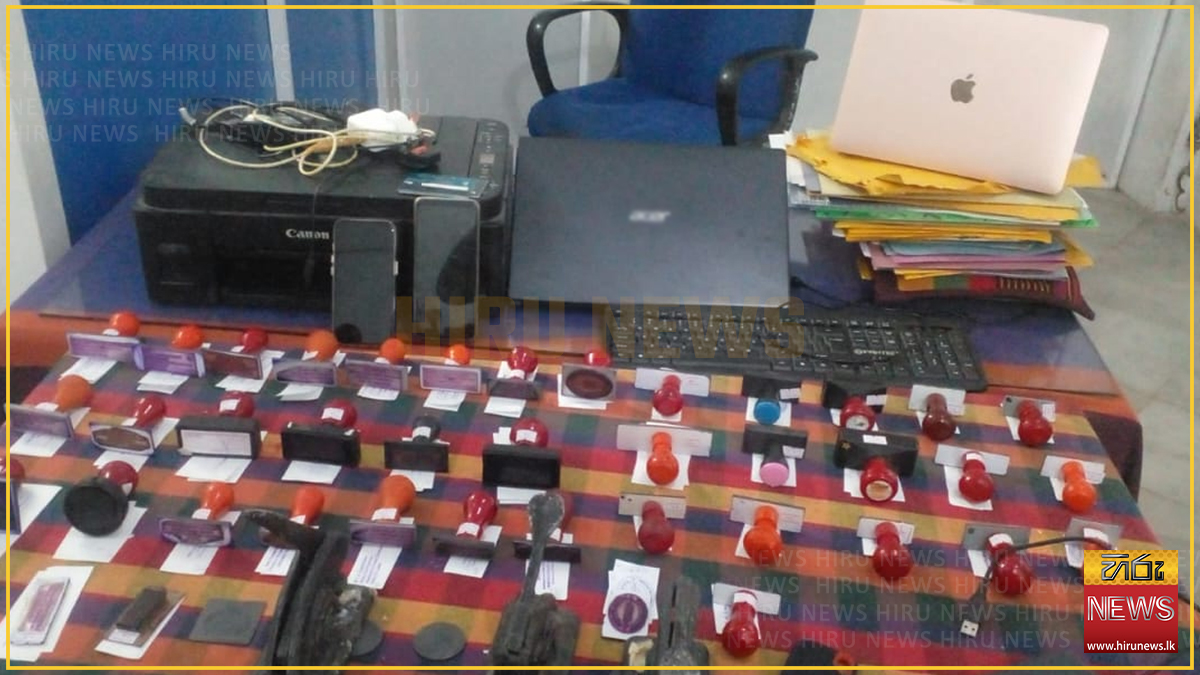
Police recovered 35 forged certificates, 51 official rubber stamps belonging to the heads of various institutions, three embossing seals, two smartphones, two laptop computers and a colour printer.
The photograph Hiru published from the scene shows the seized material laid out for cataloguing: dozens of rubber stamps, each tagged with an individual white label, alongside a Canon inkjet printer, two distinct laptops — one Acer, one Apple — and stacks of envelopes and coloured document folders. The visible equipment matches the inventory police gave.
The seals span three separate fraud markets
The recovered seals did not belong to one sector. They included those of the Department of Inland Revenue, the Department of Examinations, banks, and what police described as numerous other public and private entities.
Official stamps of seven state universities were among them: Sri Jayewardenepura, Rajarata, Wayamba, Ruhuna, Kelaniya, Moratuwa and Uva Wellassa.
That combination matters. Revenue-department seals serve tax fraud; examination and university seals serve education and employment fraud; bank seals serve financial fraud. This was not a degree mill but a general-purpose document forgery service, and police have not said which of the three lines generated most of its business.
There is also a capacity signal in the numbers. The operation held more seals than finished certificates — 51 against 35. The stock seized represents what was on hand on the day, not what the premises had produced.
The pricing tells you where the demand was
The suspect told investigators he had run the operation for about a year, selling forged certificates for between Rs. 25,000 and Rs. 50,000.
Documents forged for overseas travel were a different product at a different price: up to Rs. 400,000, roughly eight to sixteen times the domestic rate. On the operation’s own cost base, a single premium travel document covered close to a full year of the Rs. 35,000 monthly rent — a derived comparison, not a police figure.
The seizure is not the scale of the harm
The most consequential disclosure is not the inventory. The suspect told police that between 200 and 300 people who obtained documents through the operation have already travelled abroad.
Those documents are in circulation now, attached to visa files, employment applications and qualification checks in other countries. Nothing police have released indicates that any of them have been identified or recalled, and the 35 certificates seized are a fraction of that figure.
Police have not said whether the buyers are also under investigation, or whether any foreign mission, employer or university has been notified.
Context
The raid lands against a year of Sri Lankan enforcement action on document and identity fraud — from counterfeit currency in Mirihana and bank managers arrested over an import scam to Rs. 715 million in fake invoices traced by the CID. It also intersects the state’s push to formalise outbound labour migration, where verified qualifications are the gate to placement.
The Yakkala Police are continuing investigations, and the suspect is to be produced in court.
Still unstated
Whether the 200-300 who travelled abroad have been traced or their destination countries notified; how many of the 51 seals were forged versus stolen; which of the seven universities, if any, have been informed; whether buyers face prosecution; the total revenue of the operation; whether the suspect acted alone; and how the forged certificates cleared verification at the institutions that accepted them.