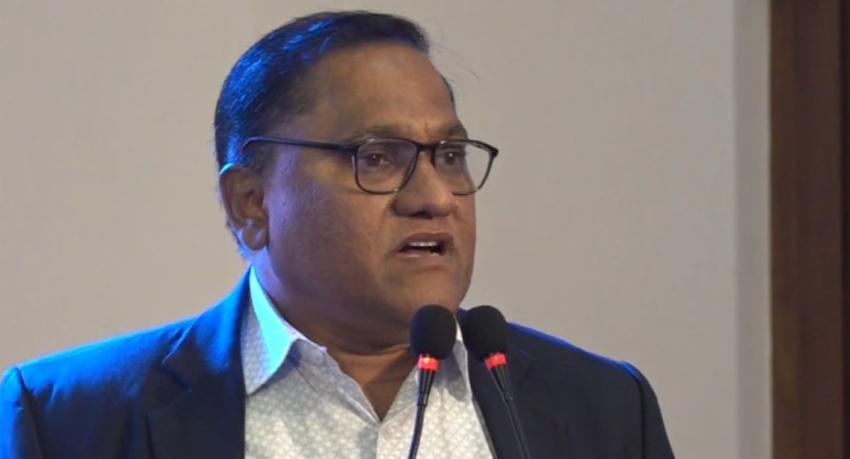
Foreign Minister Vijitha Herath has denied that the United States pressured Sri Lanka over the supply of food, water or services to Iranian vessels anchored in international waters off the island.
Washington “had neither made such a request nor exerted any pressure or intervened in the matter,” the minister said, NewsFirst reported. He said government decisions are taken while safeguarding the country’s sovereignty, independence and neutrality, and that Sri Lanka is prepared to intervene whenever humanitarian needs arise.
Herath is Minister of Foreign Affairs, Foreign Employment and Tourism. His remarks are the most senior government comment on a cluster of stranded Iranian tankers that has drawn international attention for six weeks.
The count is larger than previously reported, and the reason is Hormuz
Around 47 vessels are currently stationed outside Sri Lanka’s 12-nautical-mile territorial limit, of which about 19 are Iranian, the minister said. He noted the Iranian ships have been in the area for a long time.
The Daily Mirror adds the explanation no other account carries: Herath said the vessels are there “largely due to navigation-related challenges arising from the situation in the Strait of Hormuz,” and that Sri Lanka’s position on international shipping routes means large numbers of vessels regularly pass close to its waters, the paper reported. Cooperation and logistical support are provided to vessels when required, he said.
The figure of 19 Iranian vessels revises downward the count in earlier reporting. When LankaNewz covered the anchorage on 2 October, shipping agents and vessel-trackers described around 20 Iran-flagged tankers left without supplies as service providers withdrew rather than risk US secondary sanctions. The minister’s wider total of 47 vessels of all flags has not appeared in any previous account.
What the government says it will and will not do
Herath drew a line between state conduct and private commerce. The government has not transported goods or supplied provisions to vessels under US sanctions, he said:
“If the United States has imposed sanctions, as a government, we have not transported goods or provided supplies to those sanctioned vessels. If certain private sector individuals are providing goods and services to various such vessels, it is their responsibility to understand the prevailing situation and act responsibly. As a government, we operate in accordance with international maritime law.”
Private firms providing goods or services to sanctioned ships carry the responsibility to understand the circumstances and exercise due diligence, he said. He added that Sri Lanka acts in accordance with international maritime law and the United Nations Convention on the Law of the Sea, and that the country would not bow to external pressure or compromise its neutrality.
Hiru News reported the same denial, quoting the minister as saying the United States imposed no restrictions on the provision of food or water to the Iranian ships.
A vessel in Trincomalee, and a humanitarian precedent
The minister said Sri Lanka had intervened on humanitarian grounds when an Iranian vessel came under attack, and that the Boushehr, now at Trincomalee, remains under Sri Lankan care with 13 crew members on board. There had been no US pressure or intervention in that case either, he said. Hiru renders the ship’s name Bushehr; the Daily Mirror’s account does not mention it.
How this sits with the government’s earlier statements
The denial is the second government response in two days and goes further than the first. On Friday the Foreign Ministry’s spokesman said the US secondary sanctions announced on 24 August were a global policy measure rather than a directive aimed at Sri Lanka — a reframing of the issue, but not a denial that a warning had been delivered.
Herath’s statement is a denial. Reporting to date, including a Wall Street Journal account relayed by Hiru, had the US Embassy in Colombo telling the government in August that Sri Lankan companies servicing Iranian vessels could face secondary sanctions. The minister says no request, pressure or intervention occurred.
Not reported
No account reconciles the minister’s denial with the August embassy warning described in earlier reporting, or says whether he was addressing that specific communication. None states whether the stranded crews have since been resupplied, by whom, or on what authority, and none says what “intervened on humanitarian grounds” involved in the case of the vessel that came under attack, or when that happened. Neither the US Embassy in Colombo nor any shipping agent is quoted in response.