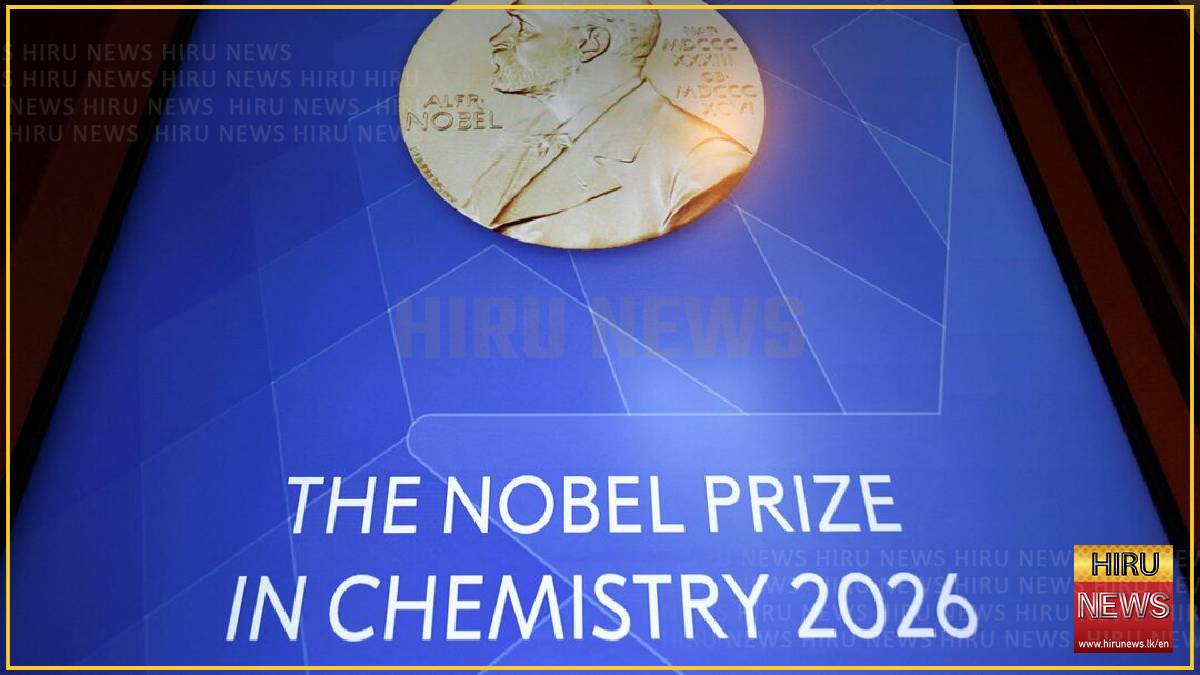
The 2026 Nobel Prize in Chemistry has been awarded jointly to Henri B. Kagan and Kenso Soai “for the discovery of non-linear effects and autocatalysis in asymmetric organic synthesis,” the Royal Swedish Academy of Sciences announced on 7 October.
Kagan, born in 1930 in Boulogne-Billancourt, France, is Professor Emeritus at what was then Université Paris-Sud. Soai, born in 1950 in Hiroshima, Japan, is Professor Emeritus at Tokyo University of Science. Al Jazeera gives their ages as 95 and 76.
The problem they solved
Many molecules exist in two forms that are mirror images of one another — like a left and a right hand. They cannot be laid on top of each other, and chemists call them chiral, from the Greek word for hand.
Life uses only one of the two. The amino acids in the proteins in human cells are all of a single handedness, a property chemists call homochirality. Its opposite number is rare in nature. How that one-sidedness could have arisen was an open question for more than a century.
The difficulty was practical as well as theoretical. When chemists ran reactions that could produce either mirror image, they got equal amounts of both. That matters most in pharmaceuticals, where typically only one version does what the drug is meant to do.
“The left-handed version of the drug can have one effect, and the right-handed version can have another effect, and then we need methods for selectively preparing them,” said Peter Somfai of the Nobel Committee for Chemistry, quoted by Al Jazeera.
Two steps, seventeen years apart
Kagan took the first step in 1986, finding a way to steer a reaction so that it yielded a far greater excess of one mirror image than had been thought possible — the non-linear effect named in the citation.
Soai took the second. A key paper in 1995 set out a reaction with the potential to be homochiral, and in 2003 he achieved it: a reaction producing only one of the two possible mirror images. Nothing other than life itself had done so before.
“Henri Kagan and Kenso Soai have provided a solution to a chemical mystery that is over a century old: how homochirality can emerge spontaneously. The chemical reactions they have developed are spectacular,” said Heiner Linke, chair of the Nobel Committee for Chemistry.
Soai’s reaction to the award, as reported by Al Jazeera: “This is the most exciting day in my life, I am very glad to share this prize with Professor Henri Kagan.”
The week’s awards
Chemistry is the third science prize of Nobel week, following medicine on Monday and physics on Tuesday. Last year’s chemistry prize went to Susumu Kitagawa, Richard Robson and Omar Yaghi for metal organic frameworks.
The laureates share 12 million Swedish kronor, divided equally, and will receive their medals from Sweden’s King Carl XVI Gustaf in Stockholm on 10 December, the anniversary of Alfred Nobel’s death.
Not reported
No Sri Lankan newsroom has carried the prize beyond Hiru News, which ran a Reuters report. That report describes the award and the Nobel week calendar but carries none of the underlying chemistry; the account of what Kagan and Soai actually discovered, and the dates of the two discoveries, comes from the Academy’s own press release.
Sources: Hiru News, Al Jazeera, The Royal Swedish Academy of Sciences.