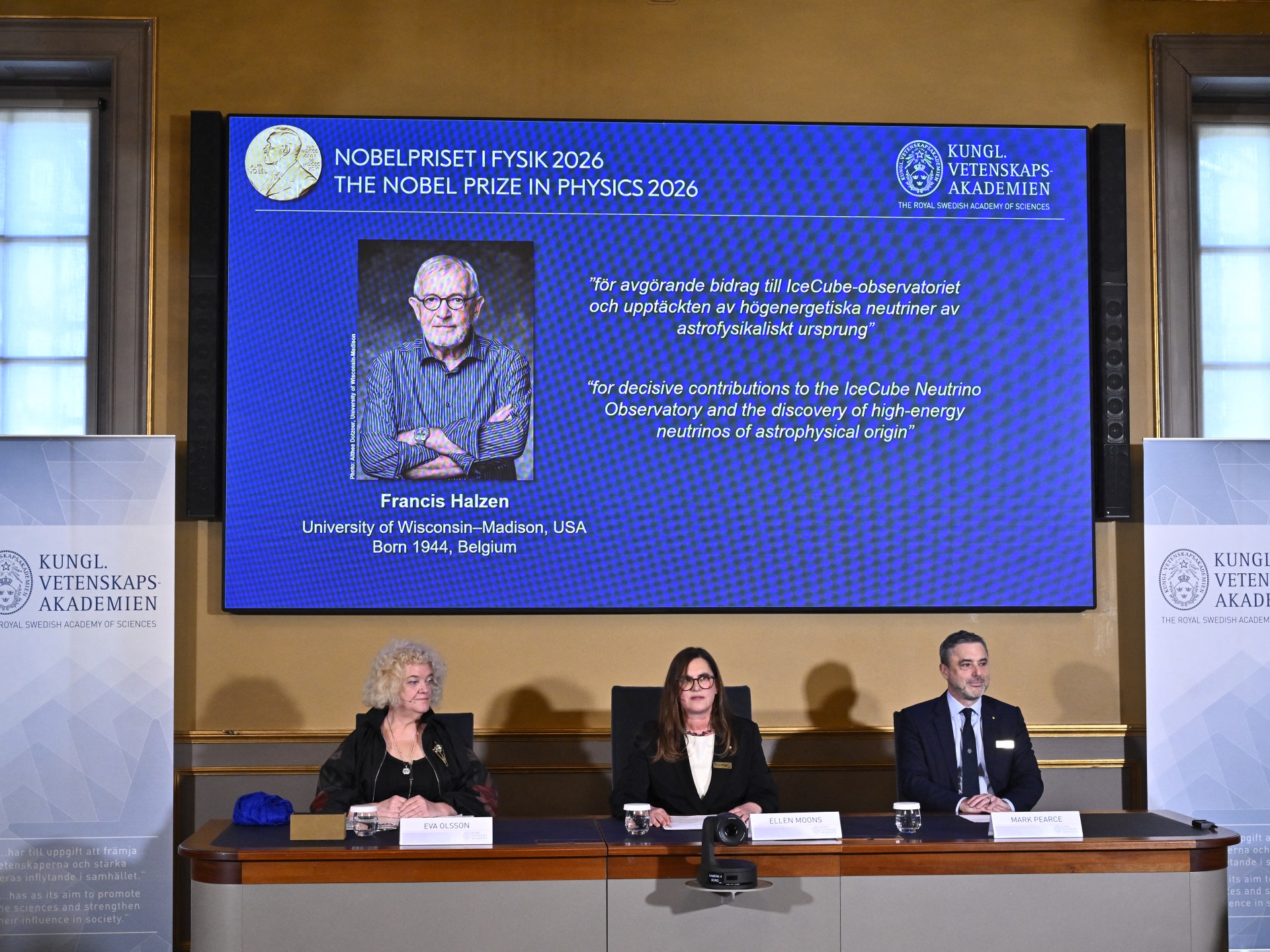
The 2026 Nobel Prize in Physics has been awarded to Francis Halzen “for decisive contributions to the IceCube Neutrino Observatory and the discovery of high-energy neutrinos of astrophysical origin,” the Royal Swedish Academy of Sciences announced on 6 October.
Halzen, born in Belgium in 1944 and now based at the University of Wisconsin–Madison, is the sole laureate.
What IceCube does
Neutrinos are subatomic particles that barely interact with anything. Billions pass through an area the size of a fingernail every second without leaving a trace. That is what makes them useful: because they carry no electric charge, magnetic fields do not bend their paths, and they travel through dense regions that block light. A neutrino’s arrival direction therefore points back towards whatever produced it.
Halzen’s insight, first presented in 1988, was that the clear, geologically stable ice at the South Pole could serve as the detector. On the rare occasion a neutrino strikes an atomic nucleus, the collision produces fast-moving charged particles that give off a faint blue flash. Sensors frozen into the ice record the pattern and timing of that light.
Because such collisions are so rare, the detector had to be enormous. IceCube covers a full cubic kilometre of Antarctic ice and was completed in 2011. Researchers reported the first evidence of cosmic neutrinos in 2013 and confirmed the discovery a few years later.
“His tenacity and scientific vision has paved the way for a new kind of astronomy,” said Mark Pearce, Chair of the Nobel Committee for Physics.
Halzen said he had not expected the award. “I have to emphasise how lucky I was. Because when we started this project, everybody realised this was maybe a good idea, but very few thought it would work, including myself.”
Committee member Eva Olsson said the high-energy neutrinos IceCube captures “opened the door to distant galaxies and tell us about the processes of exploding stars,” Al Jazeera reported.
The physics prize follows the 2026 medicine prize awarded to the three scientists behind optogenetics.
Not reported: none of the filings reviewed states the prize amount.