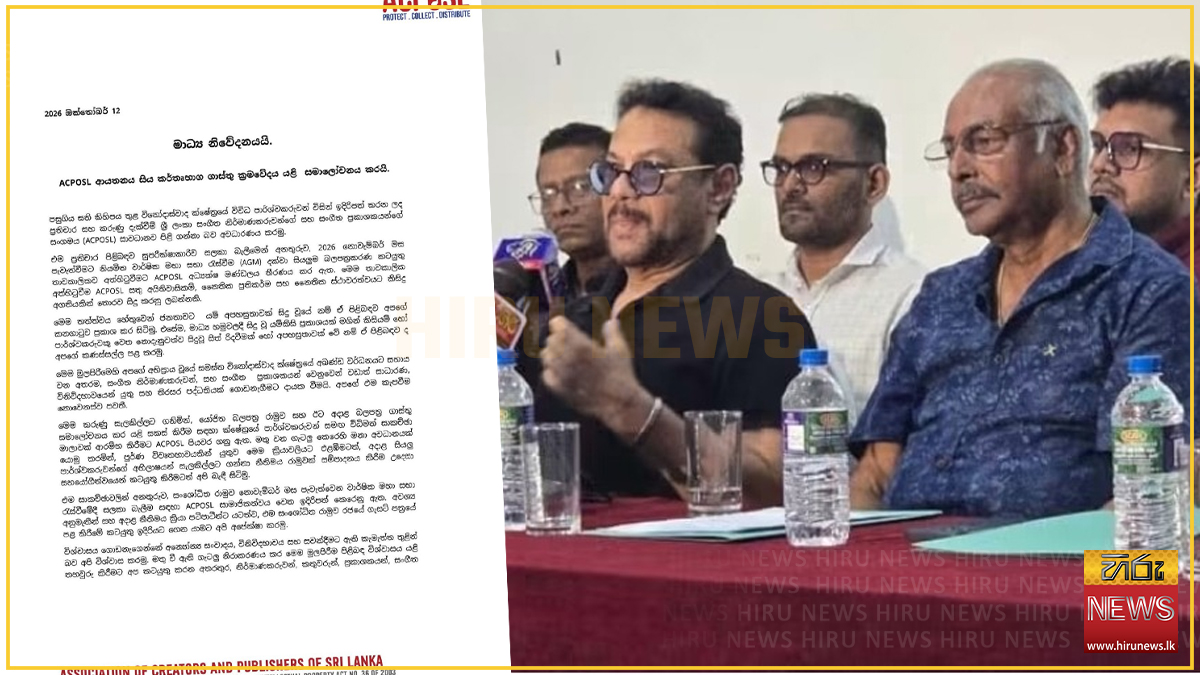
Sri Lanka’s music royalty body has suspended all of its licensing operations and said it regrets the distress its scheme caused, Hiru News reported on Tuesday — a far wider retreat than the partial pause it announced three weeks ago, and a markedly different tone.
The association said its Board of Directors took the decision after weighing responses and representations made by entertainment-industry stakeholders “over the past few weeks”. The suspension runs until the body’s Annual General Meeting in November 2026.
What is new here
This is the third stage of a retreat, and the first in which nothing is left standing.
When ACPOSL put licences on hold on 27 September, the pause covered weddings, private functions and DJ events only. Licences remained mandatory for musical shows and corporate events, and the association’s governing board publicly rejected reports that the scheme had been scrapped, saying it was suspended and under revision.
The government then intervened. On 4 October, Minister Vijitha Herath said no licence fee or other payment is required to sing or play songs at a wedding, a family function or any other private gathering, and said representatives of songwriter and musician associations had clarified that royalty arrangements were meant for commercial, ticketed events. That drew the line where ACPOSL’s own pause had drawn it — private functions out, commercial events in.
Tuesday’s notice withdraws that distinction. All licensing operations are suspended, the commercial tier included. The body has now given up the half of the scheme the minister’s statement left standing.
The tone has also shifted. In September the body was correcting the record and defending the scheme. Its new notice expresses regret over any inconvenience or distress caused to any party or to the public by “situations arising in recent days” — the first apology in the eight-week dispute.
The reservation in the fine print
The association was careful to state that the temporary suspension causes no prejudice to its rights, legal remedies, or legal standing.
That matters. The regulations that started this were gazetted on 15 September with fees of Rs. 20,000 to Rs. 125,000 banded by event type and headcount. Nothing published says they have been revoked. A suspension of licensing operations is an administrative decision to stop issuing and collecting; the instrument underneath it remains on the books, and the association has expressly preserved its position in law.
What happens next, and when
The notice sets out a sequence the earlier filings did not. ACPOSL says it will open a formal series of discussions with all industry stakeholders to review and reframe the proposed licensing framework and its fees. The revised framework then goes to the membership at the November AGM, and after that to publication in the government gazette.
That partly answers a question this desk flagged on 21 September — what the November meeting was actually for. It is a members’ vote on a redrawn scheme, with re-gazetting to follow. It does not answer whether the suspended fees could be reinstated at the same meeting.
A note on the organisation’s name
Hiru’s report calls the body the Association of Composers and Publishers of Sri Lanka. This desk’s earlier reports, following the Daily Mirror and the Sunday Times, call it the Association of Creators and Publishers of Sri Lanka. A third rendering — Authors, Composers and Publishers — also circulates.
The association’s own notice settles it. The document reproduced in Hiru’s report carries the footer “Association of Creators and Publishers of Sri Lanka” above a reference to the Intellectual Property Act No. 36 of 2003. “Creators” is the correct expansion; the acronym ACPOSL is stable across all three.
The same document is dated 12 October, a day before Hiru’s filing — so the decision was taken on Monday and reported on Tuesday.
Sourcing
No other verified newsroom had filed on this decision at the time of writing. Searches across the Daily Mirror, Ada Derana, NewsFirst, EconomyNext, the Daily FT, the Island, the Daily News and Colombo Gazette returned only the September and early-October editions of the story. This report therefore rests on a single verified newsroom, with the association’s own notice visible in that report as corroboration of the decision, its date and the body’s name.
Not reported
The notice does not say what happens to anyone who paid a licence fee between 15 and 27 September, whether the 15 September gazette will be formally amended or revoked, who will take part in the promised stakeholder discussions, or whether the November AGM could reinstate the suspended fees rather than replace them. Nothing is said about the premises tier — supermarkets, banks, malls and cinemas — for which no fee schedule was ever published.
Sources: Music royalty collections suspended by industry association — Hiru News, October 13.