The International Monetary Fund projected global growth at 3.1% for 2026 in a World Economic Outlook released in Bangkok on Tuesday, warning that the buffers which absorbed the past few years of shocks are close to exhausted. The report is subtitled Resilience Under Strain, Urgent Choices.
“The economy has been resilient, but that resilience is reaching its limits,” said Silvana Tenreyro, the IMF’s Economic Counsellor and Director of its Research Department, presenting the report, NewsFirst reported. Growth is forecast to recover to 3.4% in 2027. Global headline inflation is projected at 4.7% this year, easing to 4.1% next.
Where Sri Lanka sits
The Fund put Sri Lanka’s 2027 GDP growth at 3.7%, with inflation at 5.4% and unemployment at 3.9%, EconomyNext reported. Sri Lanka’s Extended Fund Facility concludes in March 2027, and the government is in talks on a successor programme.
The 5.4% inflation projection sits above the 5% target the government formally retained for three more years on 1 October. The Central Bank’s own forecast has inflation stabilising “around 5%” from the second quarter of 2027.
The figure that did not move
Today’s 3.1% is reported as an upgrade — it is 0.1 percentage points above the IMF’s July forecast of 3.0%, and the Daily Mirror’s wire report is headlined accordingly. Measured over a longer window, the number has gone nowhere. The April edition of the same report also put 2026 global growth at 3.1%, itself a 0.2-point cut from January’s 3.3%. The forecast fell to 3.0% in July and has now returned to where April left it. None of today’s filings note this.
What has changed underneath is the composition. Growth is now concentrated in 32 countries accounting for 95% of global growth, against 54 countries in April, the Daily Mirror reported, carrying BNN Bloomberg copy. “The global economy is not simply slowing or accelerating; rather, growth is being reallocated across countries according to their exposure to the war-induced supply shock and AI-related demand strength,” the report says.
Two forces, pulling opposite ways
The Fund frames the year as a contest between the Middle East energy shock, acting as a negative supply shock, and an AI-driven investment boom. Both push inflation up. Energy exporters and economies inside the AI supply chain fare relatively well; energy importers outside it do not.
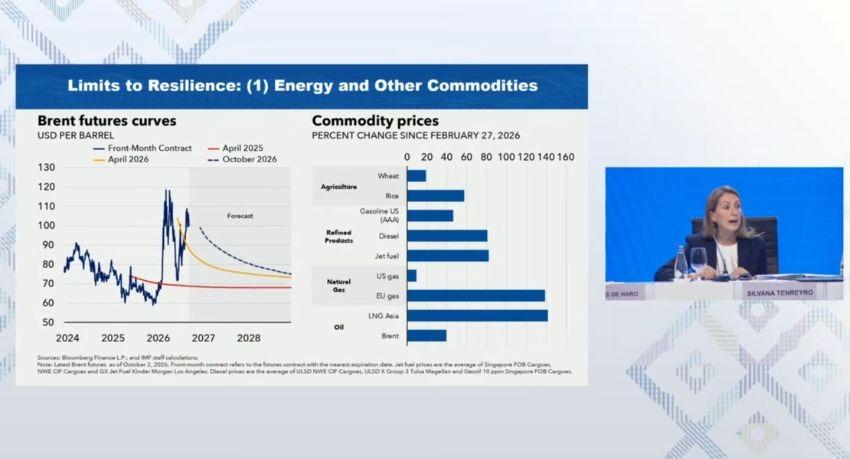
The projections rest on oil rising nearly 41% this year to average US$96 a barrel, on Strait of Hormuz shipments resuming by March, and on AI demand moderating. The United States is forecast at 2.3% in both years, the euro area at 1.1% and 1.2%, China at 4.5% (down from 5%) and India at 7% (down from 7.7%). Emerging and developing economies slow to 3.7% from 4.5% in 2025.
Managing Director Kristalina Georgieva called AI’s labour-market effect “a slow moving tsunami, but a tsunami nonetheless,” estimating around 40% of jobs globally would be augmented, downgraded or eliminated over time.
The Gulf problem behind the remittance line
The outlook credits “domestic demand, tourism and remittance inflows” for modest upgrades to oil-importing economies — the group Sri Lanka belongs to. The same outlook projects the economies that generate those remittances contracting sharply.
The Middle East and Central Asia is the only region forecast to shrink in 2026, at −0.3% against the 1.9% expansion projected in April, Al Jazeera reported. Kuwait is forecast at −16.7%, Iraq −16%, Qatar −15.6%, Bahrain −11.3%, Iran −7.6% and Saudi Arabia −3.3%. The Daily Mirror’s report supplies the recovery figure Al Jazeera omits: 6.3% growth for those regions in 2027.
Sri Lanka’s nine-month remittances reached US$6.87 billion, up more than a billion dollars on last year — but September’s year-on-year gain was 5.6%, the slowest month of 2026.
The oil assumption, measured
The Fund’s US$96 average gives a number to a question Sri Lankan policymakers have so far answered qualitatively. The Central Bank’s inflation forecast rests on the Middle East conflict easing; Governor Nandalal Weerasinghe’s August benchmark for managing inflation was US$80 a barrel, and Brent was trading above US$100 by early October. The IMF’s assumption sits between the two.
The slide Tenreyro presented, titled “Limits to Resilience: Energy and Other Commodities,” plots Brent futures curves dated April 2025, April 2026 and October 2026 against latest futures as of 2 October. The October curve runs well above the April one across the whole forecast horizon before declining — the assumed Hormuz normalisation, drawn. A companion chart measuring commodity price changes since 27 February 2026, when the war began, shows Asian LNG and European gas as the largest movers, ahead of diesel and jet fuel, with Brent and food staples smaller.
Not reported
None of the four filings gives the IMF’s current projection for Sri Lanka’s 2026 growth. EconomyNext describes the 2027 figure as a moderation, which implies a higher 2026 outturn — but the number itself is absent, and in April the Fund had cut Sri Lanka’s 2026 growth to 3.1% from 3.5%. Nor do the filings say whether Sri Lanka’s projections were revised up or down from the July edition, or what oil price the Fund assumes for 2027 beyond the March normalisation date.
