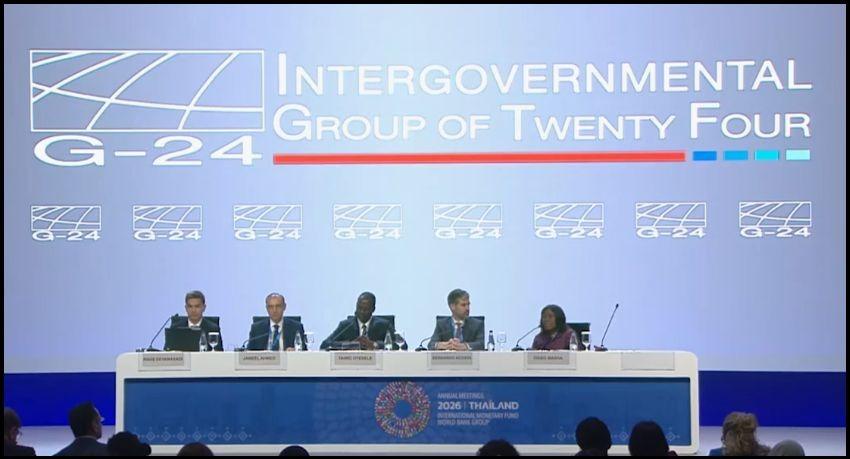
Sri Lanka’s prolonged debt crisis has become a key reference point in efforts to strengthen the global sovereign debt restructuring system, the G24 Secretariat says — while cautioning that significant gaps in that system remain unaddressed.
Secretariat Director Iyabo Masha made the remarks at a media briefing, responding to a question from NewsFirst’s Zulfick Farzan. The attribution matters: this is an answer given to a Sri Lankan newsroom that asked about Sri Lanka, not a statement the G24 issued on its own initiative.
Excessive debt remains a major constraint on growth, Masha said, because heavily indebted countries are forced to direct a significant share of their resources to servicing debt rather than investing in development.
What has changed since
Masha said important reforms have been introduced since Sri Lanka’s restructuring, producing what she described as a more robust sovereign debt architecture, with countries in distress now expected to reach resolutions faster than in the past. She identified four changes:
- The IMF has updated its Debt Sustainability Framework, introducing new metrics for assessing a country’s debt-carrying capacity — intended to help governments judge how much debt they can sustainably manage and reduce the risk of future crises.
- The Global Sovereign Debt Roundtable has revised its restructuring playbook. Masha noted this is the same platform that played a crucial role during Sri Lanka’s own negotiations. The revisions are expected to speed resolution and improve coordination between creditors and debtors.
- The Common Framework and other mechanisms aimed at developing countries have been strengthened, including updates to key memoranda of understanding intended to streamline negotiations.
- A Borrowers’ Platform Governing Council has been launched, led by UNCTAD, with Pakistan taking the chairmanship. It is intended to give debtor nations a collective voice, allowing them to share experience and engage more effectively in international debt discussions.
Reference point, not author
NewsFirst headlines its filing “Sri Lanka Changed the Global Debt Playbook.” Masha’s reported words are more measured, and the distinction is worth preserving.
She describes Sri Lanka as a reference point in ongoing reform efforts, and places the reforms as having come since the restructuring — a sequence, not a claim of causation. The one direct link she draws is to the Global Sovereign Debt Roundtable, which she says played a crucial role in Sri Lanka’s negotiations and has since rewritten its playbook. Nothing in the account has the G24 crediting Sri Lanka with authoring the changes.
What is still broken
The second half of Masha’s answer is the part the headline framing obscures. She said further reform is still required, and named two specific failures:
Credit rating agencies. Masha called on advanced economies to support changes in how international rating agencies assess developing nations, arguing that current practices can place additional pressure on countries already in difficulty.
Private creditors. She pointed to limited private sector participation in global debt resolution initiatives, noting that countries with significant exposure to private bondholders often cannot access the full benefits of restructuring mechanisms because stronger private involvement is absent. That is a direct description of the position Sri Lanka itself occupied — a sovereign whose debt stock included substantial international bondholdings alongside its official creditors.
Reflecting on Sri Lanka’s experience, Masha said the international community has made significant progress since the height of the crisis, but that substantial work remains before debt-distressed countries can expect timely, fair and sustainable resolutions.
Not reported
This is a single-source report, and NewsFirst’s own question is its origin. Sweeps of EconomyNext’s homepage and of ft.lk’s front-page and top-story sections returned no G24 filing — reliable negatives — and the Daily Mirror’s latest-news listing carried none. Ada Derana has been unreachable to this desk for twenty-five consecutive days. This appears to be a genuine exclusive rather than a story other outlets declined.
Masha does not say what Sri Lanka’s restructuring specifically demonstrated, or which features of its case drove which reform. She gives no date for the IMF’s updated Debt Sustainability Framework or the revised Roundtable playbook, no detail of what the memoranda of understanding changed, and no indication whether the reforms would have altered Sri Lanka’s own timeline had they existed in 2022.
The filing does not say where the briefing was held, though it comes during the week of the IMF–World Bank Annual Meetings, where Central Bank Governor Nandalal Weerasinghe also spoke on Sri Lanka’s anti-money-laundering evaluation and the IMF published the World Economic Outlook covered here on 13 October. No response from the Sri Lankan Treasury or Central Bank to the G24’s assessment is reported.