Dengue cases are rising again in Sri Lanka, and the National Dengue Control Unit attributes the increase to the rain that has fallen across the island over the past week.
Acting Director of the NDCU Dr. Kapila Kannangara said mosquito breeding sites have increased under the prevailing wet conditions, and that a recent larval survey found a higher larval density, NewsFirst reported.
Taking the current situation into account, he said, plans are under way to launch another mosquito control programme covering selected areas within the next two weeks.
The same official predicted this, a month ago
The significance of Friday’s statement is not in the statement itself but in what preceded it.
On 15 September, Dr. Kannangara told the Daily Mirror that dengue cases had declined from the high-risk levels recorded earlier in the year — at the peak, he said, between 1,200 and 1,300 cases were being reported daily — and credited health authorities and public cooperation for the reduction.
In the same remarks he warned that dengue could resurface with the rains expected in the coming months, citing the northeast monsoon, El Niño conditions and the inter-monsoon period. A special one-week control programme had been launched the previous day, 14 September, precisely to pre-empt that resurgence: six provinces, 15 districts and the Colombo Municipal Council area, with ten teams deployed to each Medical Officer of Health area, each team made up of a health worker, a member of the military, a police officer and volunteers.
That September filing is a month old and is therefore cited here by its dateline — “Colombo, Sep. 15 (Daily Mirror)” — rather than listed as a source for current reporting.
The forecast has now been met by the event. The rains arrived: this desk has reported an eight-day spell that flooded Colombo roads, a flood alert on the Nilwala and advisories across most of the island. Friday’s statement confirms the second half of the September warning. No filing makes the connection.
What the two programmes tell you
Read together, the September and October programmes describe a cycle rather than a response. The September operation was pre-emptive, nationwide in reach and ran for one week. The October operation is reactive, confined to “selected areas,” and has not yet begun — it is planned for some point within the next fortnight.
A pre-emptive programme covering 15 districts did not prevent the resurgence it was launched to prevent. That is the fact on the record, and neither the September nor the October filing addresses it.
Why rain drives this
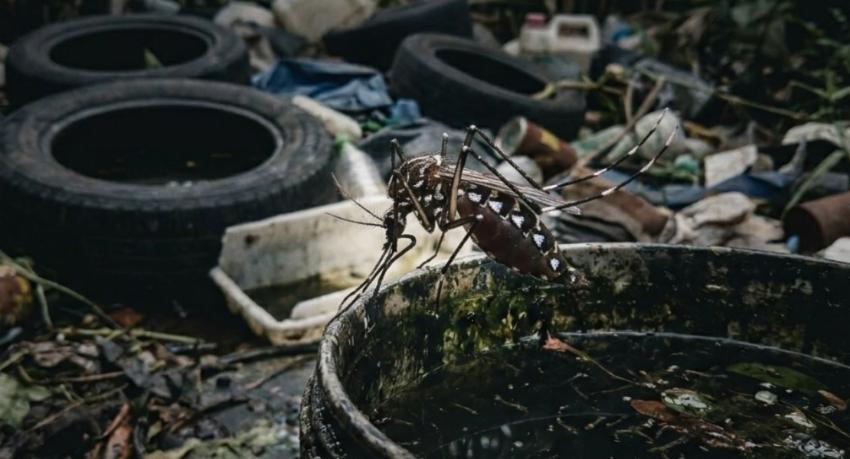
Aedes mosquitoes breed in small volumes of standing clean water, so rainfall multiplies breeding sites — discarded tyres, containers, roof gutters, construction sites — within days, and larval density follows. This is why the NDCU’s entomological surveys function as a leading indicator: a rise in larval density precedes a rise in cases, which is the sequence Dr. Kannangara described on Friday.
Context from earlier this year
The last national figures this desk carried, from 12 July, put the year’s caseload at 68,672 cases and 47 deaths, with the Western Province accounting for the largest share and Gampaha having overtaken Colombo as the worst-affected district. June was the worst month recorded to that point, and the Public Health Inspectors’ Union described it as a “hyper-epidemic” while the GMOA had earlier called for a presidential task force.
Those are July figures. They are not current, and they should not be read as the present caseload.
Not reported
Friday’s filing contains no numbers at all. It gives no current case count, no death toll, no figure for the larval density it describes as higher, no baseline to compare it against, and no indication of how much cases have risen or over what period. It does not say which districts are affected, which “selected areas” the new programme will cover, when within the fortnight it will begin, how long it will run, or what it will consist of.
Nor does it say whether hospital admissions have risen, whether the Western Province remains the worst affected, or whether the September programme was assessed before this one was planned.
This article rests on a single verified source. Searches of the other verified newsrooms returned no same-day filing on these remarks; the Daily Mirror maintains a continuously updated dengue tracker page, but it carries no fixed publication date and is not citable as a dated source. Figures circulating in search summaries for the national caseload could not be traced to any current filing from a verified newsroom and are deliberately omitted here rather than repeated.
Source: NewsFirst.