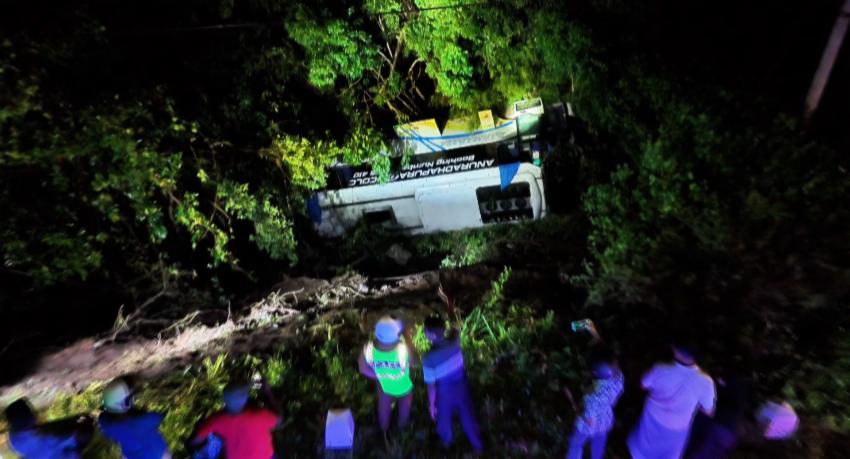
Two passengers were injured on Saturday night when a stone fell onto a private bus at Kadugannawa, on the main Colombo–Kandy road, Hiru News reported at 10.04 p.m. Colombo time.
Police said the two injured were passengers travelling in the bus. That is the extent of the official account so far: the filing does not give the victims’ condition, name the hospital they were taken to, state the exact location along the pass, or say whether the road was closed.
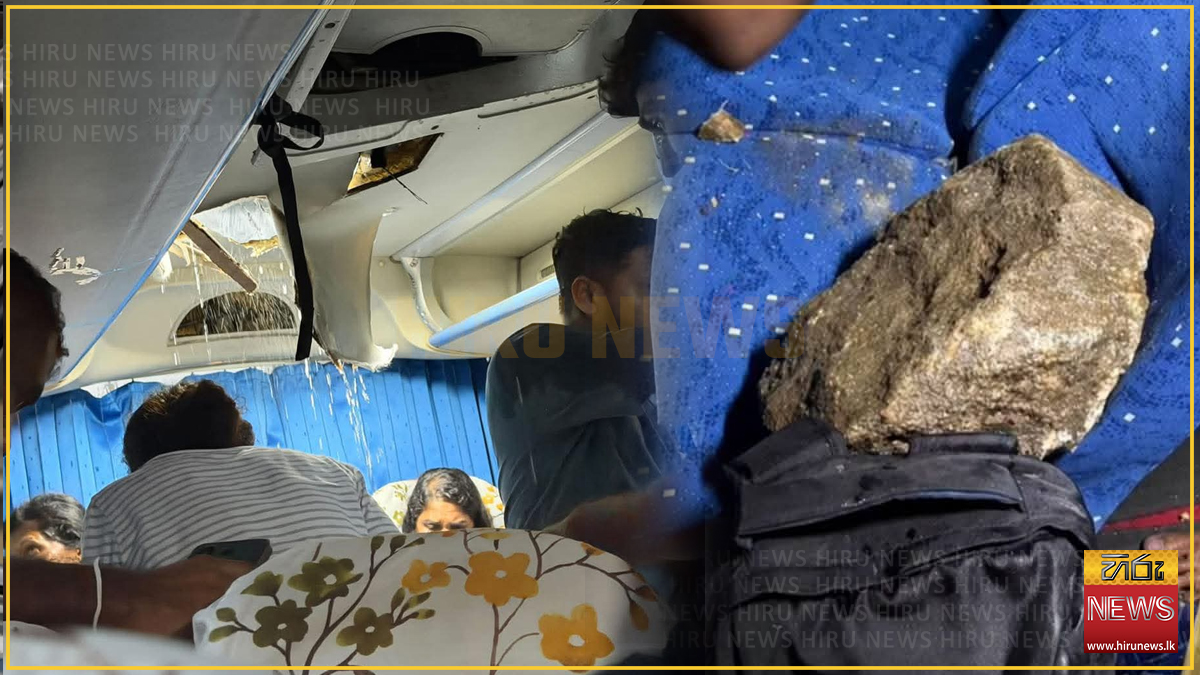
Hiru’s own photograph from the scene shows more than the text does. It was taken inside the bus and shows the roof punctured through — metal torn upward and open sky visible through the breach — with water running in through the hole onto the seats below, and the recovered stone, roughly the size of two hands, being held up beside it.
An advisory for the same hills, issued hours earlier
The Department of Meteorology had warned the same evening that showers or thundershowers were likely in most parts of the island over the following few hours, and that rainfall exceeding 100 mm was possible in the Sabaragamuwa and Central provinces and in the Badulla district, Hiru reported at 8.47 p.m. — about an hour and a quarter before the Kadugannawa filing.
Note how that advisory is drawn. It names two provinces and one district, and Badulla sits in Uva Province, not in Central. Readers checking whether their area is covered need to read both lines, not only the province list.
Kadugannawa lies in the Central Province, which the advisory covers. No filing attributes the rockfall to the rain, and the Met Department has not commented on the incident. The two reports are recorded here as the same evening in the same warned area, not as cause and effect.
The advisory also gives no cause for the rainfall itself. That is worth noting because the stated cause has moved during this month’s wet spell: filings from 11 to 14 October attributed the rain to a low-level atmospheric disturbance in the Bay of Bengal, while a 15 October advisory attributed continuing rain to changes in the prevailing wind pattern.
This stretch is a designated high-risk zone
What gives a single falling stone its weight is where it fell.
In September this desk reported that the section of the Colombo–Kandy main road between the 96th and 99th kilometre posts at Lower Kadugannawa has been formally identified as a high-risk landslide zone, on the basis of National Building Research Organisation (NBRO) hazard maps, the record of previous failures along that stretch, and the landslides triggered by Cyclone Ditwah — see Colombo–Kandy road at Lower Kadugannawa declared high-risk landslide zone.
A US$101.3 million mitigation project for the affected areas — US$80 million in Asian Infrastructure Investment Bank loan assistance and US$21.3 million from the Government of Sri Lanka — was scheduled to begin, with completion set for December 2027. Nothing published on Saturday says whether that work has started, and neither Hiru filing places the fallen stone within the designated three-kilometre stretch.
The precedent on the same pass
The most serious recent failure at Kadugannawa was not a near miss. On 23 November 2025, a rockfall and earthslip at Ganethenna, Pahala (Lower) Kadugannawa crashed into a shop and a neighbouring house, trapping ten people. Four were pulled from the debris and taken to Mawanella Hospital, two of whom died of their injuries; police put the death toll at six by the evening of 22 November. The Disaster Management Centre’s situation report that weekend recorded more than 800 people affected by heavy rain across multiple districts.
That account comes from The Morning, dated 23 November 2025. It is noted here as background and is not cited as a source for Saturday’s incident — it falls outside this desk’s sourcing window, and the two events are unconnected except by location and by the hazard the NBRO designation describes.
Not reported
No filing gives the condition of the two injured passengers, the bus route or operator, the number of people aboard, or whether traffic on the Colombo–Kandy road was disrupted. Nothing says whether the NBRO was called to assess the slope, whether the stretch has been restricted, or whether the stone came from a slope already under monitoring.
Neither is there any official statement linking the fall to the evening’s rainfall, or any word on the status of the US$101.3 million mitigation project.
Both reports on this page come from a single newsroom. This desk found no second verified outlet carrying either the rockfall or Saturday evening’s advisory at the time of writing; searches returned only older Kadugannawa rockfalls and earlier rain advisories from other months.