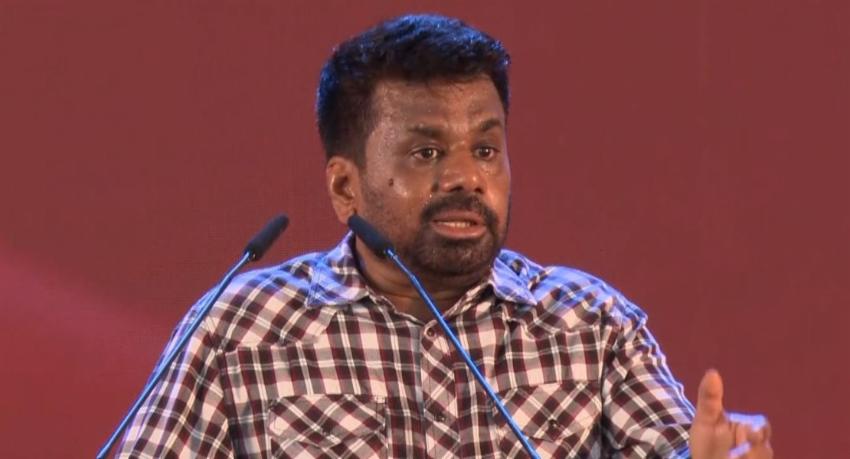
President Anura Kumara Dissanayake said on Saturday that the government will not proceed with the proposed Protection of the State from Terrorism Bill or the Prevention of Organised Crimes Bill without first consulting the public and relevant stakeholders — and will not put either to a vote in Parliament until a broad consensus is reached.
He was addressing the National Trade Union Convention at the P.D. Sirisena Grounds in Maligawatte, Colombo, the gathering the governing National People’s Power is holding to mark two years in office.
The decision had been reached at a discussion held earlier the same morning, the President said, the Daily Mirror reported. The government would hold discussions with all concerned parties, including the civil society organisations that had raised concerns about the proposed legislation, with the aim of reaching a broad consensus before proceeding.
NewsFirst reported the commitment in a stronger form: the two Bills would not be put to a vote in Parliament until that consensus had been reached through consultations with stakeholders and civil society. The convention was also attended by Deputy Minister of Finance and Planning Anil Jayantha Fernando and Minister of Agriculture, Livestock, Land and Irrigation K. D. Lal Kantha.
”We are not a government that stays in power through laws and regulations”
The President said his government had no intention of using laws and regulations to retain power.
“We are not a government that stays in power through laws and regulations.”
He added that his administration would respect the democratic will of the people and would be prepared to step down if voters decided to remove it from office through an election.
Hiru News reported the same passage from the Sinhala original in sharper terms. There the President names his own party and the category of law directly: the National People’s Power does not need repressive laws (මර්දන පනත්) so long as it has the public, and is “not a force prepared to stay in power through repressive laws.” On an election he is quoted as saying: “If the people say go to the next election, we are ready to go.”
The two English filings render this as the softer, more general “laws and regulations”. The Sinhala is the language the address was delivered in, and it is the more specific of the three accounts — the pledge is about repressive legislation, which is the category both contested Bills are being placed in by their critics, rather than about lawmaking in general.
What this changes
The pledge goes further than the position the President set out two days earlier. On 5 November he signalled three specific amendments to the Organised Crimes Bill — cutting the proposed detention period from 72 hours to 48, and revisiting the tattoo-related and Excise Ordinance provisions. That was an offer to change the text. Saturday’s statement is a commitment about process: no vote until consultation produces consensus.
What it is not is a withdrawal. Neither filing says the Bills have been shelved, sets a timetable for the consultations, names who will be invited, or says what would count as “broad consensus” or who decides when it has been reached.
The opposition the Bills have drawn
Both Bills have attracted sustained objection across the legal, rights and business sectors over the past month:
| Body | Position |
|---|---|
| Bar Association of Sri Lanka | Called for withdrawal of both Bills |
| Human Rights Commission of Sri Lanka | Called for withdrawal |
| Amnesty International | Called for withdrawal |
| Human Rights Watch | Warned of rights abuses |
| PAFFREL | Wrote to the President |
| Ceylon Chamber of Commerce | Raised GSP+ risk |
The Organised Crimes Bill is also before the Supreme Court on petitions challenging its constitutionality, and Cardinal Malcolm Ranjith said this week that the church was studying the proposed anti-terrorism law. Trade unions and public-sector groups have protested against both, which makes the choice of a trade union convention as the venue for the announcement notable in itself.
A naming point worth noting
NewsFirst’s headline and text refer to the “proposed Prevention of Terrorism Act”. That is the name of the existing law. The Bill actually before Parliament is the Protection of the State from Terrorism Bill, which is what the Daily Mirror calls it and what the government’s own drafting uses. The two are frequently conflated in coverage; the PTA is the statute the new Bill is intended to replace.
Also announced
The same address carried the government’s signal of a further PAYE threshold increase in the 2027 Budget, due on 12 November. NewsFirst adds that several essential allowances are set to be raised in that Budget, many by 100%, and that increases to other allowances would be considered only after the revised basic salary structure takes effect in January 2027.
Not reported
Neither filing gives a date, format or convenor for the promised consultations, says whether the Supreme Court proceedings will continue in parallel, or records any response from the Bar Association, the rights commissions or the civil society organisations the President referred to. Neither says whether the amendments offered on 5 November still stand, or whether the consultation reopens the full text.


