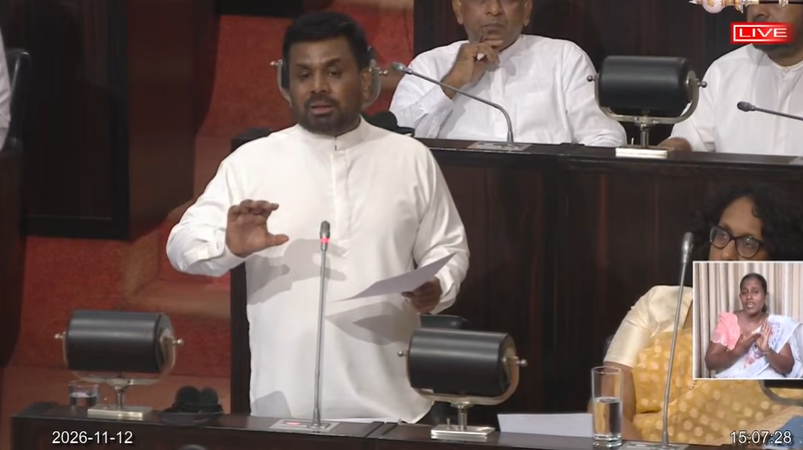
Sri Lanka will cut existing CESS import taxes by 25 per cent across 800 selected customs code lines from April 2027, and remove the 10 per cent Ports and Airports Development Levy on imported newsprint and solar storage batteries from 1 January 2027, President Anura Kumara Dissanayake announced in the 2027 Budget speech on Thursday.
The CESS reduction covers 800 selected Harmonized System (HS) code lines and is the second phase of a government programme to phase out import tariffs, EconomyNext reported.
“To simplify the import tax structure, reduce trade costs, and boost economic competitiveness, I propose cutting existing CESS rates on 800 selected HS code lines by 25 per cent,” the President told Parliament.
The Daily Mirror reported the same measure, describing the aim as simplifying the import tax structure, reducing trade-related costs and improving the competitiveness of the economy.
What it costs the Treasury
The two measures carry published revenue estimates. The CESS cut is projected to cost Rs 10,000 million a year, and the PAL changes Rs 350 million a year, according to the government’s 2027 revenue impact summary cited by EconomyNext.
The same summary puts the total annual revenue the state expects to forego across all proposed budget tax changes at Rs 28,415 million. The PAL loss begins in January 2027 and the CESS loss in April 2027.
Two different start dates
The port levy change comes first. The 10 per cent PAL currently charged on imported newspaper printing paper under specified HS codes is removed, as is the levy on batteries used to store solar energy.
“I propose removing the existing 10 per cent Ports and Airports Development Levy currently charged on the import of newsprint under specified HS codes, effective January 1, 2027,” the President said.
The Daily Mirror’s separate filing on the levy states the 1 January 2027 date applies to both newsprint and solar storage batteries, reporting that the levy on “imported newsprint and batteries used for solar energy storage will be removed with effect from January 1, 2027.” EconomyNext attaches the explicit date only to the newsprint clause in its transcript of the speech, but separately records the PAL revisions as taking effect in January 2027.
The battery measure sits alongside the rooftop solar subsidy announced in the same speech, which this desk covered in Budget 2027 offers up to Rs 250,000 for home solar batteries.
Not reported
No filing lists which 800 HS code lines are covered by the CESS cut, nor what the first phase of the tariff-removal programme covered or when it took effect. Neither outlet says why the CESS reduction is deferred to April while the PAL removal starts in January, and none gives the expected effect on retail prices for either newsprint or batteries.