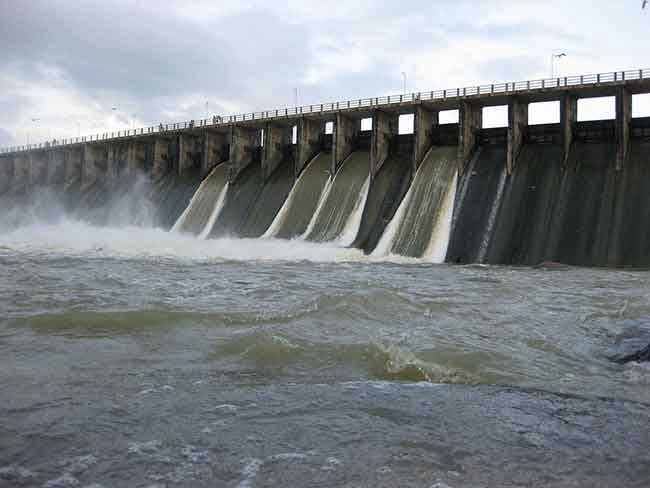
Sri Lanka’s Irrigation Department says 33 of its reservoirs — 16 major and 17 medium-scale — are currently spilling as sustained heavy rains push storage above capacity, with several major dams releasing thousands of cubic feet of water per second into downstream river systems.
Director of Water Management Engineer H.M.P.S.D. Herath said the situation was confirmed at 6.00 a.m. on Tuesday and is expected to worsen as showers continue. The department urged residents in low-lying areas and communities along rivers and waterways to stay alert for rising water levels.
Among the major reservoirs spilling are Rajanganaya in Anuradhapura, Ambewela in Badulla, and Mau Ara, Lunugamvehera, Tissa Wewa, Weerawila Yoda Wewa and Weheragala in Hambantota. The Ambakola Wewa, Usgala Siyambalangamuwa, Magalla and Deduru Oya reservoirs in Kurunegala have also exceeded spill levels, alongside Nalanda and Wemedilla in Kandy, Alikota Ara in Monaragala and Yoda Wewa in Mannar.
Twelve spill gates of the Rajanganaya Reservoir are open, releasing more than 14,000 cubic feet of water per second into the Kala Oya. Six gates of Lunugamvehera are discharging over 4,100 cubic feet per second into the Kirindi Oya, while six gates of Weheragala are releasing more than 2,400 cubic feet per second into the Menik Ganga. Four gates of Deduru Oya are open at 2,800 cubic feet per second.
The Department of Meteorology has issued a red warning for heavy rains of more than 150mm in the Western, Sabaragamuwa, Central and Northwestern provinces and the Galle and Matara districts, with the Disaster Management Centre separately warning of landslide risks across 11 districts.
The spillways are operating amid the same pre-monsoon low-pressure system that prompted the morning rainfall advisory, which forecast accumulations above 200mm across the western catchments that feed the country’s largest reservoirs.