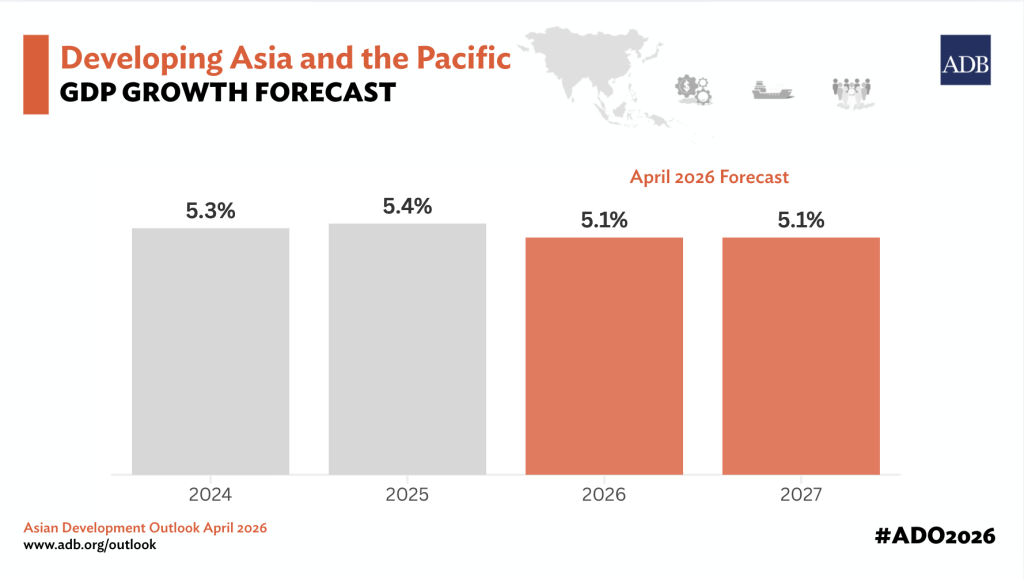
The Asian Development Bank has cut its growth forecast for developing Asia and the Pacific to 5.1% for both 2026 and 2027, down from 5.4% in 2025, citing the Middle East conflict as the single largest risk to the region’s economic outlook.
The projections, published in the ADB’s Asian Development Outlook (ADO) April 2026 on Friday, paint a sobering picture for a region grappling with trade disruption and elevated energy costs. Regional inflation is projected to climb to 3.6% in 2026, up from 3.0% last year.
Key Forecasts
China’s growth forecast was trimmed to 4.6% from 5.0%, while India was revised down to 6.9% from 7.6%. Pacific economies face the sharpest deceleration, falling from 4.2% in 2025 to 3.4% this year. Oil prices are expected to remain elevated in the near term.
“A prolonged conflict in the Middle East is the single biggest risk to the region’s outlook, as it could lead to persistently high energy and food prices and tighter financial conditions,” said ADB Chief Economist Albert Park.
Sri Lanka Implications
The ADB cautioned that disruptions to fertiliser markets linked to the conflict could add inflationary pressure on global food prices — a particular concern for Sri Lanka, which is already contending with the Strait of Hormuz disruption, elevated fuel costs, and a 44% US tariff shock.
The ADO noted that its forecasts were finalised on March 10 under “exceptionally high uncertainty,” and that evidence since then points to a higher likelihood of more persistent disruptions. A prolonged Middle East conflict could affect regional economies through shipping disruptions, elevated price pressures, and financial volatility.
The report did not include a Sri Lanka-specific country chapter in this release.