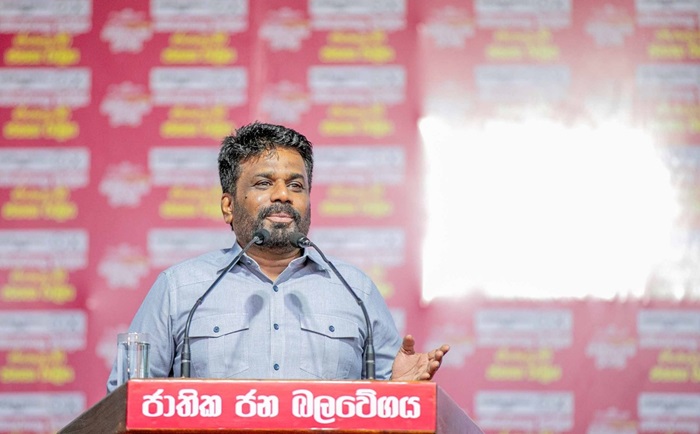
President Anura Kumara Dissanayake announced on Friday that the Government will allocate Rs. 2,000 billion (Rs. 2 trillion) for capital expenditure in 2027, claiming it would be the largest such allocation in Sri Lanka’s history. He cited the Treasury’s improved cash position as the basis for the commitment.
“During 2022 and 2023, the Treasury overdraft stood at LKR 800 billion, and the Treasury functioned on borrowed funds. However, we have now succeeded in maintaining the Treasury with a positive balance,” he said, according to Newswire.
The President was speaking at the relaunch of construction on the stalled Ampara Multipurpose Town Hall and Nindavur Cultural Centre, valued at Rs. 1,744.85 million and Rs. 945.04 million respectively. He framed the capex push as proof that improved fiscal management had restored the state’s capacity to fund development directly, including in rural and Eastern Province communities that had received less attention under previous governments.
He said separate consultations with parliamentarians were under way to identify priority projects to be financed under the 2027 allocation. The figure marks a substantial step up from current capital spending levels, which have been constrained by the IMF programme’s fiscal-consolidation conditions.
The announcement landed alongside the President’s reassurance that “2022 will not happen again,” citing $7bn in foreign reserves, and as the rupee recovered sharply to Rs. 329 in the spot market on Friday after weeks of pressure. The IMF Executive Board is scheduled to consider Sri Lanka’s fourth programme review on May 27.
The Rs. 2,000bn target, if realised, would mark a structural shift in public investment. Capital spending was effectively suspended during the 2022–23 default period when the Treasury relied on Central Bank overdrafts to meet basic operating expenses.
Pledge restated in Galle, with a spending-mix target
Update, July 28: The President repeated the Rs. 2 trillion commitment more than two months later and attached a target for the shape of government spending, not just its size.
Speaking at the Galle District Special Coordination Committee meeting held at the Galle District Secretariat on Tuesday (28), Dissanayake said public resources should be directed towards the country’s progress rather than towards maintaining government operations, Ada Derana reported, citing a statement from the President’s Media Division.
He said economic plans for the coming year had been drawn up with the objective of reducing recurrent expenditure, which he put at 9%, while raising capital expenditure from its current 4%. The Rs. 2 trillion capital allocation planned for 2027 represents an increase of approximately 40%, he said. The report did not specify the basis against which those percentages are measured.
Reporting on the same meeting the following day, NewsFirst said the session reviewed progress on development projects funded under the 2026 budget allocations, including the Galle District Development Plan. Dissanayake stressed that public funds must be properly used for development work, and pressed officials on housing projects that had been left stalled midway.
The restatement keeps the figure consistent with what Cabinet Spokesman Nalinda Jayatissa set out in June, when he put 2026 capital expenditure at Rs. 1,350 billion against Rs. 5,500 billion in 2025 revenue. Execution, rather than allocation, remains the open question: the Presidential Secretariat’s own mid-year review found capital expenditure execution had fallen to 17.4%.
Sources: Newswire, Ada Derana — Rs. 2 trillion to be allocated for capital expenditure in 2027, NewsFirst — President Calls For Accountability In Development Spending.