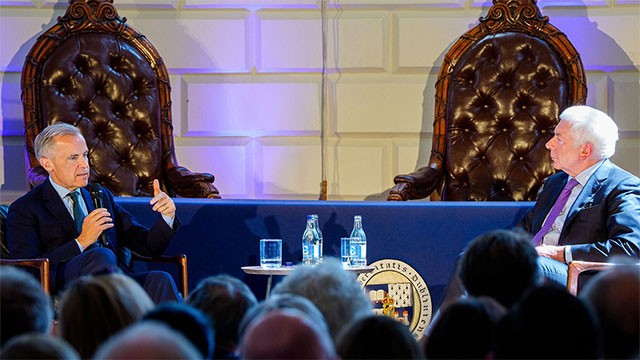
Canadian Prime Minister Mark Carney said the “strands” of a new world order could be woven at the 52nd G7 summit, to be hosted by France in Évian-les-Bains from June 15 to 17, speaking at an interactive session at Trinity College Dublin during a six-day official visit to Europe.
Carney noted that the gathering will be expanded well beyond the bloc’s traditional core membership, with specialised invitees from India, Brazil, Egypt, Kenya and the Gulf states joining deliberations. Incorporating these players, he said, ensures external participants will inject “a broader perspective and a broader element of the solution”. He framed the change as an explicit acknowledgement of shifting global power: “It’s a recognition that the G7, if it ever did run the world, no longer runs the world or pretends to.”
The Canadian leader singled out Artificial Intelligence as a critical area where international frameworks lag the technology, warning that the lack of regulation exposes societies to risks ranging from child exploitation to cyber incursions on critical digital infrastructure. “The importance of sharing the defences, having common standards, not releasing models that have that power before others are ready — that is an imperative. That is something I’m certain we will be discussing at the G7,” he said.
The summit’s French-set agenda also focuses on stabilising international financial architecture and macroeconomic governance, global healthcare and energy security, and the Ukraine and Middle East conflicts — including the US-Iran framework deal whose signing has been forecast for Sunday. Paris has invited Ukraine, India, Brazil, Egypt, South Korea, Kenya, Qatar, Saudi Arabia, Syria and the United Arab Emirates as outreach partners. For Sri Lanka, the G7 economies remain the principal bilateral donors and IMF-programme stakeholders, with the ADB warning of an 0.8 percentage-point GDP hit from the recent conflict and the G7 finance chiefs earlier flagging Middle East war effects on the world economy.