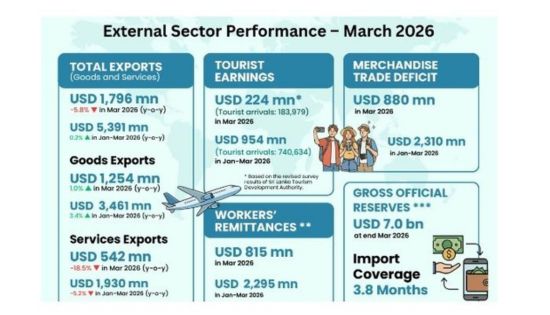
Sri Lanka’s external current account recorded a marginal surplus in March 2026 despite a widening trade deficit and falling services earnings, according to the Central Bank’s External Sector Performance Summary released Thursday.
The Q1 cumulative current account surplus reached $531 million, supported by stronger workers’ remittances and a lower primary income deficit. The merchandise trade deficit, however, widened to $2.3 billion in the first quarter from $1.5 billion a year earlier, as imports outpaced exports.
Fuel import expenditure jumped 74.7% year-on-year to $630 million in March, driven by higher prices and volumes linked to the Middle East conflict and the Hormuz blockade. Vehicle imports remained elevated at $195 million in March and $613 million for the quarter.
The services account surplus fell 42.4% to $227 million in March on a sharp drop in tourism receipts. Tourist arrivals dropped 19.8% year-on-year to 183,979 in March, with monthly earnings estimated at $224 million. Cumulative tourism earnings declined 15% in Q1.
Workers’ remittances rose to $815 million in March, up 17.5% on the year, with cumulative Q1 inflows growing 26.5%. Foreign investment flows remained negative, with $64 million in net outflows from the government securities market and $10 million from the Colombo Stock Exchange.
Gross official reserves stood at $7 billion at end-March, including the People’s Bank of China swap facility. The CBSL attributed the monthly decline to external debt servicing. The rupee had depreciated 2.9% against the US dollar by end-April, the central bank said, citing external pressures from the Middle East conflict.
Sources: Newswire.