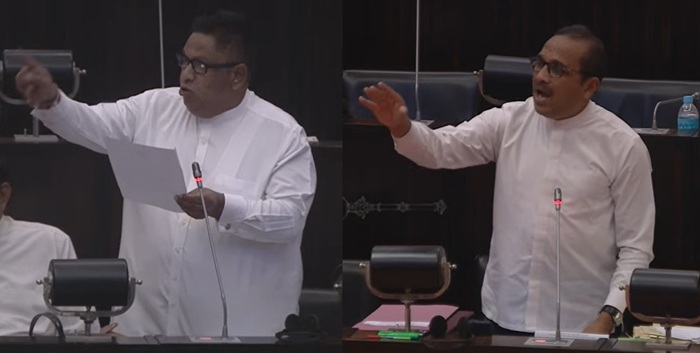
A tense exchange broke out in Parliament on Wednesday when Opposition MP Chamara Sampath Dassanayake attempted to raise a grievance over the Bribery Commission’s court-ordered travel ban that prevented him from joining a Chinese government-sponsored programme for parliamentarians on May 5–6.
Dassanayake told the House his passport was in court custody and that, despite tabling a motion supported by a letter from the Parliament Secretary General and the official Chinese invitation, repeated objections from the Bribery Commission (CIABOC) had blocked his travel.
Speaker Jagath Wickramaratne intervened to shut the matter down. “The court has issued an order. We cannot discuss issues of the court in Parliament,” he said.
Leader of the House and Transport Minister Bimal Rathnayake reinforced the ruling, telling the MP the issue was not a parliamentary privilege matter. “However, we gave you a chance to speak on it. What you are saying now is against regulations. I request you not to fall victim to other people’s political agendas. You are an accused in the case, there is a court order related to your case, and it cannot be spoken in Parliament,” he added, according to Newswire.
A heated exchange followed between Dassanayake, the Speaker, Rathnayake and other MPs in the chamber.
The travel restriction at the centre of Wednesday’s row was imposed by the Colombo High Court at the request of the Bribery Commission in connection with corruption charges Dassanayake faces over a 2016 Uva Provincial Council cheque deposit during his time as Chief Minister. The Colombo High Court had temporarily lifted the same travel ban on May 18 on a defence motion seeking permission to travel — but that lifting came after the China programme had already passed.
The episode marks the first time a sitting MP under active CIABOC prosecution has openly contested a travel restriction on the floor of the House since the new Anti-Corruption Act came into force, and it places fresh strain on the Bribery Commission’s enforcement posture as multiple high-profile cases — including those against former Central Bank Governor Ajith Nivard Cabraal and former president Mahinda Rajapaksa — move through the courts.