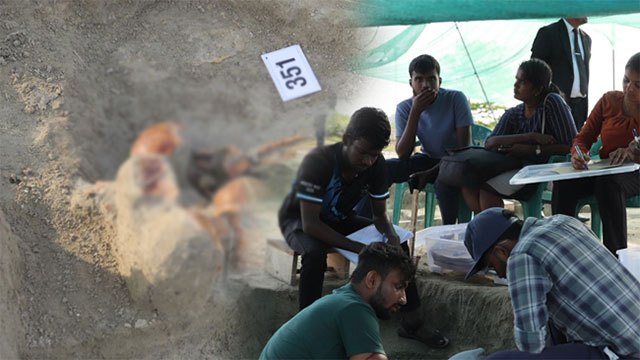
The mass grave at Chemmani Siththupaththi in Jaffna has become the largest such site recorded in the Northern Province in recent history, with the total number of skeletal remains exhumed rising to 351.
Ten additional sets of remains were unearthed on Monday during the 25th day of the sixth phase of excavations, taking the cumulative total past the previous record held by the former Sathosa building site in Mannar, where 342 sets of remains had been recovered between 2018 and 2019.
Attorney-at-Law V.K. Niranjan, appearing on behalf of relatives of the disappeared, said that by the end of Monday skeletal remains belonging to 360 individuals had been identified at Chemmani, of which 351 had been exhumed.
The excavation is being carried out under the direct supervision of Jaffna Magistrate S. Leninakumar by a team of experts including Senior Professor of Archaeology Raj Kumar Somadeva of the University of Kelaniya and Consultant Judicial Medical Officer Dr. Sellaiah Piranavan of the University of Jaffna, Ada Derana reported. All skeletal remains and artefacts recovered to date are being securely held under court order at the Faculty of Medicine, University of Jaffna.
Since the sixth phase began on April 27, 2026, the remains of 112 individuals have been exhumed from the site. By the close of the fifth phase on September 6, 2025, the running total stood at 239 individuals. The pace of recovery has therefore accelerated sharply over the past seven weeks, with the count climbing from 245 at the end of the previous campaign in early May and through the 327-remains milestone reached on Day 20 of the current phase.
Investigators have also recovered fragments of skeletal remains believed to belong to small children, alongside a piece of gold jewellery and a number of coins.
The Chemmani site first came to public attention in 1998 during the trial of Lance Corporal Somaratne Rajapaksa, who was convicted over the 1996 rape and murder of Tamil schoolgirl Krishanthy Kumaraswamy and three other family members in Kaithady. Rajapaksa is reported to have disclosed information during proceedings about the burial of hundreds of victims in the Chemmani area.
The previous record holder, the Mannar Sathosa site, was later removed from immediate war-era debate after carbon-dating analysis in the United States placed those remains between 1450 and 1650 AD. Other Northern Province sites include the discovery of approximately 88 individuals at Thiruketheeswaram in Mannar in 2013, and 52 individuals at Kokkuthoduvai in Mullaitivu during 2023 and 2024 — the latter dated to the 1994–1996 conflict window.
Excavations at Chemmani are continuing.
Update — June 17: Count reaches 380 with children’s belongings recovered
The Chemmani Siddhupatthi excavation entered its 27th day of the current phase on Tuesday with another 14 sets of skeletal remains unearthed, taking the cumulative count of remains identified at the site to 380, Newswire reported. Of those identified, 362 had been exhumed by the close of Tuesday’s session.
Nearly 120 artefacts have now been recovered alongside the remains, including baby milk bottles, toys, children’s shoes, school bags and coins — material consistent with the recovery of children’s remains documented earlier in the phase. The excavation continues under the supervision of Jaffna Magistrate Selvanayagam Leninkumar and the lead expert team of Professor Raj Somadeva and Dr. Sellaiah Piranavan. Officials from the Ministry of Justice and the Office on Missing Persons are scheduled to visit the site on Wednesday.
Update — June 19: Justice Minister visits site, says funds allocated
Justice and National Integration Minister Harshana Nanayakkara visited the Ariyalai Siththupathy Chemmani site on Friday to inspect ongoing excavations, telling reporters that the work is “progressing successfully” and that the funds needed to complete the process have been allocated, Newswire reported.
The Minister said the excavations should be completed as quickly as possible to ensure justice is served. Speaking to reporters at the site, he fielded questions on the excavation process and on parallel investigations into missing persons.
The site visit was attended by Office on Missing Persons Chairman Mahesh Katulanda, former Colombo Judicial Medical Officer Dr. Ajith Tennakoon, Jaffna District MPs K. Ilankumaran and Rajeevan Jeyachandramoorthy, the Ministry’s legal team and senior officials from the Ministry of Justice and National Integration. Work at the site continues under the leadership of Senior Professor Raj Somadeva with archaeology students, forensic experts and medical professionals.
Sources
- Chemmani becomes largest mass grave unearthed in Northern Province as exhumed remains exceed 350 — Ada Derana, June 16
- Chemmani mass grave: remains of 10 more bodies uncovered, total rises to 351 — Newswire, June 16
- Chemmani Mass Grave: 380 Human Remains Identified as Excavation Continues — Newswire, June 17
- Justice Must Be Served: Minister Inspects Chemmani Mass Grave Excavations — Newswire, June 19