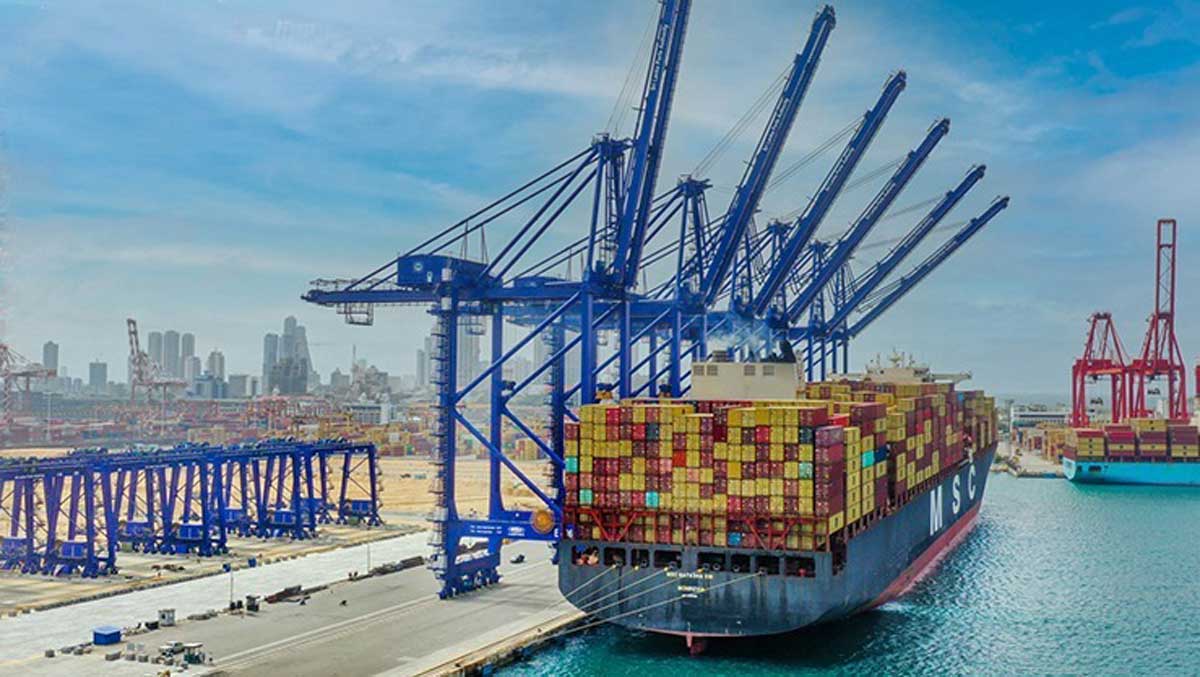
Colombo Port handled 8.2 million twenty-foot containers (TEUs) in 2025, ranking it among the world’s top 25 seaports by volume, but its efficiency standing on the World Bank’s Container Port Performance Index has collapsed to 80th out of 403 — down from 17th in 2020 and 28th in 2022, EconomyNext said in a Sunday explainer.
Adani-controlled Colombo West International Terminal (CWIT) handled 1 million TEUs in its first year of operation with just eight quayside cranes, and is targeting 3.5 million TEUs at full capacity with a workforce of 250, Chief Operating Officer Iresh Siriwardena told the newsroom. CWIT averaged 25 container moves per hour in February 2026, with a target of 28 next year. Privately operated CICT and SAGT terminals already rival the world’s best, at 35 and 30 moves per hour respectively, while state-owned Jaya Container Terminal averages 21.
Transshipment accounts for 81% — or 6.6 million TEUs — of total volume, with Indian cargo making up 45% of that traffic. Siriwardena said the port could have handled 10 million TEUs in 2025 but for congestion, citing the August 2025 rerouting of Mediterranean Shipping Company’s Himalayan Express service to India’s Vizhinjam port. One global shipping line CEO said Colombo could attract 15 new weekly services and reach 30 million TEUs in five years if surplus capacity existed.
The piece flags structural bottlenecks: a Sri Lanka Customs time-release study shows the median Full Container Load import takes 44 hours 23 minutes to clear, against just 24 minutes in Singapore. Less than Container Load imports take over three days. Border agencies still require printed copies of documents already filed digitally through the ASYCUDA system, with customs officials citing the 1869 Customs Ordinance. Sri Lanka ratified the WTO Trade Facilitation Agreement in 2016 but has not delivered the promised single-window system.
Romesh David, former SAGT chief, said the Sri Lanka Ports Authority’s overlapping role as landlord, owner, operator and regulator is the structural problem. Rohan Masakorala of the Shippers’ Academy warned Sri Lanka risked becoming “just another port, not that dream mega maritime hub” without separating regulation from operation.
The analysis comes shortly after Colombo Port’s April 2026 throughput rose 22% year-on-year and CICT set a single-vessel handling record with MSC Ingy.
Source: EconomyNext — EXPLAINER: How to reverse the decline of Sri Lanka’s Colombo Port.