Sri Lanka’s post-crisis recovery is entering a more difficult phase as policymakers, economists and businesses contend with rising geopolitical tensions, volatile energy markets and growing uncertainty in the global economy, a Gamani Corea Foundation and Sri Lanka Economic Association seminar in Colombo heard.
Setting the scope of the discussion on “Sri Lanka’s Current Macroeconomic Policy Directions in the Current Global Volatility,” SLEA President Prof. Sirimevan Colombage said Sri Lanka, as a small open economy, remained highly vulnerable to external shocks while still recovering from the 2022 crisis and the aftereffects of Cyclone Ditwah. Recent US tariff actions and the conflict in the Middle East had compounded those pressures, he said.
Keynote speaker Central Bank Deputy Governor Dr. Chandranath Amarasekara warned that Sri Lanka cannot afford a return to the “stop-and-go” model driven by fiscal stimulus, money printing and untargeted subsidies. He said the economy expanded beyond $100 billion for the first time in 2025 and per capita GDP exceeded $5,000, but the country had repeatedly failed to sustain growth momentum. Reaching Singapore’s current per capita income would take 102 years at 3% annual growth, 62 years at 5% and 39 years even at 8%, he said.
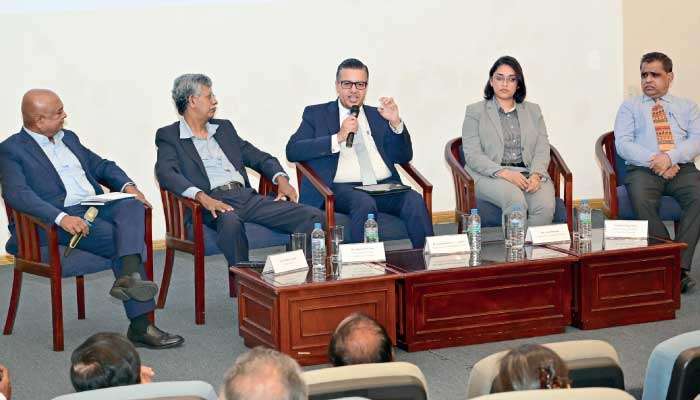
The panel — including Ceylon Chamber of Commerce Economist Arani Rodrigo and Peradeniya University Senior Prof. O.G. Dayaratna-Banda — urged that export growth, reserves, fiscal discipline and investment be treated as critical buffers, while warning that businesses face mounting logistics, insurance, wage and energy costs. The speakers framed the global turbulence as “creative destruction” requiring new ideas for sustainable, productivity-led growth, building on the current account deficit Amarasekara had flagged earlier this week and the oil-bill pressure bearing down on the rupee.
Source: Daily FT.