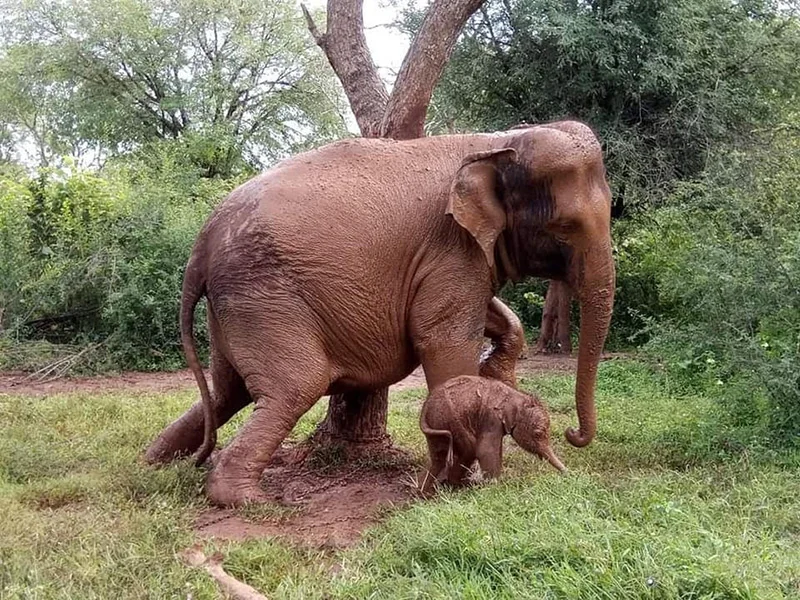
The death of “Sujeewa,” a female elephant held under state custody for nearly a decade, has reopened calls for accountability and reform in Sri Lanka’s handling of wildlife crime, with conservationists urging an immediate investigation into the circumstances of her death.
Environmental researcher Supun Lahiru Prakash has called on the Ministry of Environment and the Criminal Investigation Department to launch a comprehensive probe, warning that the death points to systemic lapses rather than an isolated tragedy. Sujeewa was taken into custody by the Department of Wildlife Conservation in February 2016 in a high-profile case involving the illegal capture and trade of wild elephants, and had been held at a holding facility in Udawalawe where she later gave birth to a calf.
“If an adult elephant, held for years by the authorities, dies without a clear and justifiable explanation, it points to systemic lapses. Either there was negligence, or something far more concerning,” Prakash told The Island. He cautioned that custodial deaths could be used by suspects in pending smuggling cases to argue private custody was safer, calling that “a dangerous narrative.”
In 2021, a since-blocked attempt by the then-government to release Sujeewa and her calf back to individuals linked to the original smuggling case via Gazette Notification 2241/41 sparked public outrage; courts subsequently halted the release.
Prakash said his research had documented at least 55 cases of illegal elephant trade in Sri Lanka between 2008 and 2018, with credible evidence of involvement by wildlife officers, politicians and influential individuals. The death of another seized juvenile, “Siewali,” from Gannoruwa, also remains unresolved, and another elephant under similar custodial conditions is reported to be suffering severe health complications. Wildlife crime has surfaced repeatedly in Sri Lankan courts, with Bathiudeen’s Wilpattu encroachment case before the Supreme Court the most recent high-profile track.