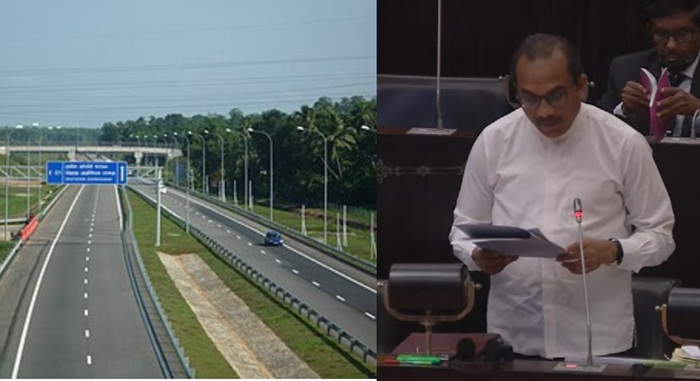
Sri Lanka’s expressway network earned Rs. 16,330.14 million in toll revenue during 2025 against maintenance costs of Rs. 5,180.90 million, Transport and Highways Minister Bimal Rathnayake told Parliament on Wednesday — leaving a roughly Rs. 11.15 billion surplus across 312.57 kilometres of road.
The minister’s full-year breakdown, responding to a question from Opposition MP Ravi Karunanayake, is the first granular disclosure of expressway-by-expressway economics since the network was opened to traffic.
The Southern Expressway (E1) led on both sides of the ledger, generating Rs. 5,031.28 million in revenue against Rs. 2,024.5 million in upkeep on its 200.45-km Kottawa-Mattala stretch. The Outer Circular Expressway (E2) followed with Rs. 4,347.32 million revenue for 28.86 km, requiring Rs. 767.6 million to maintain. The Colombo–Katunayake Expressway (E3) collected Rs. 3,355.12 million on 25.8 km at a cost of Rs. 834.1 million.
The Southern Expressway Extension (E5) from Andarawewa to Hambantota earned Rs. 2,019.45 million across 16.55 km at Rs. 1,022.7 million in maintenance — proportionally the highest per-kilometre upkeep cost on the system. The Central Expressway (E4), the newest 40.91-km Mirigama–Kurunegala segment, brought in Rs. 1,576.97 million at Rs. 531 million in maintenance.
The figures land as the Ministry pushes through several parallel reform tracks: the automated toll payment system due by year-end, the Rs. 112 billion Rambukkana–Galagedara Central Expressway extension approved by Cabinet on May 12 and the restart of the Ruwanpura Expressway with a March 2027 target.
Earlier this year the network also produced two visible seasonal totals — Rs. 441 million over nine days of Avurudu travel and Rs. 536 million across a 10-day window — peaks that feed into the full-year figure now tabled in the House.