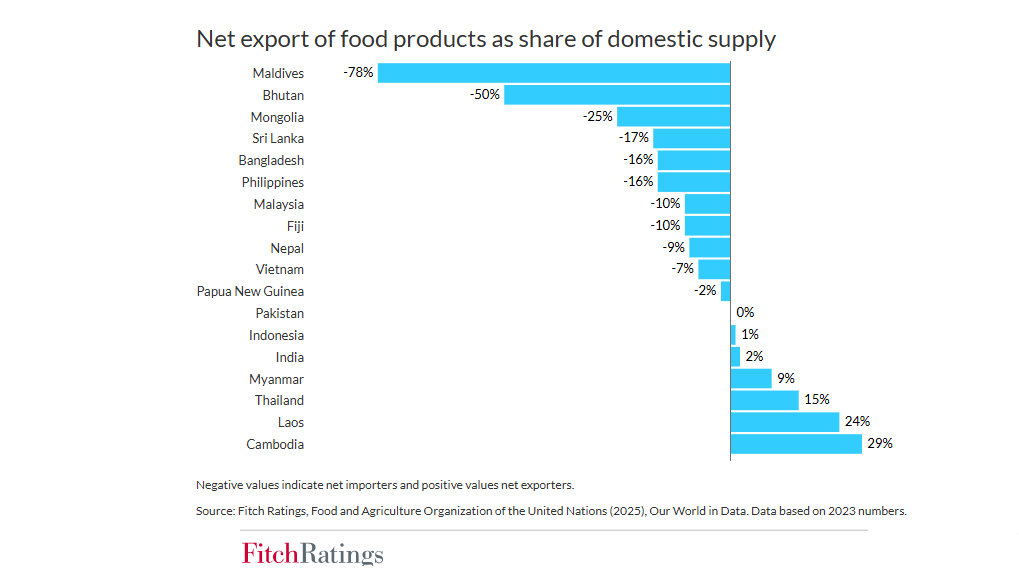
Sri Lanka would face rising cost pressures across agribusiness and food supply chains if a prolonged US-Iran war pushes fertiliser supply disruption deeper into the planting season, Fitch Ratings said in a report dated April 23.
Countries more reliant on imported food, including Sri Lanka, Bangladesh and the Philippines, would see margin pressure and higher food prices later in 2026, Fitch warned. The agency said food-import dependence is in the mid-teens on a net basis across the three countries.
“Countries that are more reliant on imported food would be more exposed if weaker domestic harvests coincide with elevated global food prices and export restrictions in traditional food suppliers,” Fitch said.
The Gulf region produces much of the world’s fertiliser, as natural gas is a key feedstock. Reduced fertiliser availability and higher prices would raise production costs, discourage application rates, and weaken crop yields, the report said.
Fitch warned that fiscal pressure would increase through corporate and household channels if governments provided subsidies to stabilise fertiliser and food supplies. Where such support is limited, higher costs would fall more directly on farmers, food companies and consumers, potentially heightening social tensions.
Sri Lanka relies heavily on imported urea and other fertiliser inputs, and Prof. Buddhi Marambe of the University of Peradeniya has previously warned that prices for the next shipment could reach USD 800 per metric tonne against USD 650 per tonne for the last procurement. The Yala season sowing window is under direct pressure from these cost dynamics.