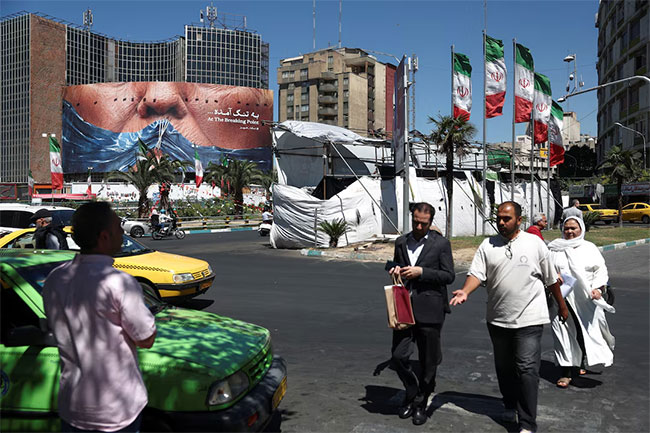
The United States and Iran have reached an outline agreement to extend their ceasefire pending President Donald Trump’s approval, Axios reported on Thursday, Ada Derana said, citing Reuters. The deal followed an Iranian missile attack on a US air base in Kuwait that itself came in retaliation for fresh US strikes on what Washington described as an Iranian drone operation. US officials separately told the BBC that the framework of a deal had been agreed, pending approval from Trump and Iran’s leadership.
Under the outline, the two sides agreed a 60-day memorandum of understanding to extend the tenuous early-April truce and to open negotiations on Iran’s nuclear programme. The plan still needs Trump’s signoff. There was no immediate confirmation of the report, although it was enough to send oil prices, which had rebounded earlier in the day, lower again. Trump told reporters at a Cabinet meeting on Wednesday he was not yet satisfied with the negotiations and that Washington was not discussing easing sanctions, one of Tehran’s central demands. Treasury Secretary Scott Bessent, briefing reporters at the White House on Thursday, said the outcome rested with the President. “Everything depends on what the president wants to do,” Bessent said, adding that Trump “is not going to make a bad deal for the American people.” Vice-President JD Vance, speaking later on Thursday evening, told reporters in Washington that negotiators were still “going back and forth on a couple of language points,” including the question of uranium enrichment, but said the Iranians were negotiating in “good faith.” “We’re not there yet, but we’re very close and we’re going to keep on working at it,” he said. Iran’s semi-official Tasnim news agency reported that the deal had not been finalised.
The day’s exchanges underscored how fragile the diplomatic track remains. US Central Command said American forces shot down five Iranian attack drones and struck a ground control station in Bandar Abbas that was about to launch a sixth. Kuwaiti forces then intercepted a ballistic missile fired toward Kuwait, which hosts a large US base. “These actions were measured, purely defensive and intended to maintain the ceasefire,” a US official told Reuters. The Islamic Revolutionary Guard Corps said it had targeted the US base responsible for the dawn strike near Bandar Abbas Airport and warned that any repeat would trigger a “more decisive response,” according to Iran’s Tasnim agency.
Kuwait condemned the attack and demanded that Iran immediately halt what it called a serious escalation. The flare-up coincided with Eid al-Adha celebrations across the region, where multiple countries have been drawn into the war that erupted on February 28 with US and Israeli strikes on Iran. In Lebanon, which Iran insists must be part of any wider peace deal, Israel said it had begun striking Hezbollah infrastructure in the southern city of Tyre and had carried out a strike in Beirut. The Lebanese army said one of its soldiers had been killed; Israel said air-raid sirens had sounded in its north.
Pakistan’s mediation role was thrown into sharp relief by Islamabad’s announcement that Foreign Minister Ishaq Dar would meet Secretary of State Marco Rubio in Washington on Friday, although the significance of the visit was unclear. Treasury Secretary Scott Bessent separately warned Oman on X that the United States would “aggressively target” any actors, “directly or indirectly,” involved in facilitating tolls in the Strait of Hormuz. Trump, who had earlier threatened to “blow up” Oman if Muscat sought a role in managing the strait, reiterated that no single country would control the waterway. Tehran expressed solidarity with Oman after what it called “U.S. officials’ threats.”
For Sri Lanka, whose fuel cargoes transit Hormuz, an extended truce — even an outline one — would ease the pressure that has driven up tanker insurance, freight premiums and global crude prices. Each round of renewed US strikes and Iranian retaliation since Monday’s defensive action near Bandar Abbas has pushed those costs higher, complicating the IMF’s downgraded growth outlook for the year.