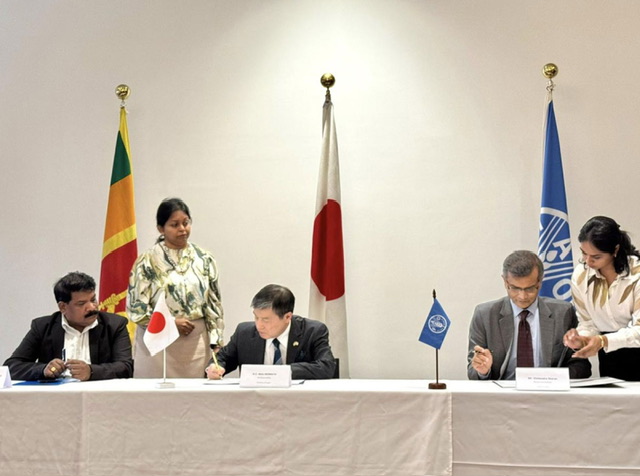
Japan and the United Nations Food and Agriculture Organization (FAO) have launched a USD 1.33 million project — about Rs. 436 million — to restore livelihoods and rebuild the freshwater fisheries sector in Sri Lanka’s Eastern Province, the partners said after an agreement signing at the Japanese Embassy in Colombo on May 29.
The project, fully funded by the Japanese Government with FAO providing technical implementation, is targeted at fishing communities battered by Cyclone Ditwah in November 2025. Eastern Province reservoirs are a major source of cage-cultured tilapia and other freshwater stock, and several inland fisheries cooperatives lost cages, nets and hatchery inputs during the storm.
Key components include the installation of 200 fish cages across 30 selected reservoirs, the supply of barrage net systems, upgrades to the Inginiyagala Fish Breeding Centre in Ampara, technical training for fisheries associations, and the free distribution of fish fingerlings and feed for the first cultivation cycle. The package is intended to get cooperatives back into production rather than only restoring physical infrastructure.
Speaking at the ceremony, Fisheries Minister Ramalingam Chandrasekar said the project marks a significant milestone in modernising Sri Lanka’s freshwater fisheries industry and in scaling up production through advanced cage culture technology. Japanese Ambassador Akio Isomata said strengthening inland fisheries was critical to Sri Lanka’s food security, particularly as the marine fisheries fleet faces sharply higher fuel costs after the recent diesel price hike. He reaffirmed Tokyo’s continued support for Sri Lanka’s sustainable development.
The signing is the second Japan-funded inland fisheries package in two years and follows similar FAO-implemented support for cyclone-hit vegetable farmers backed by Australia. The Humanitarian Preparedness Plan covering wider Ditwah recovery formally closed at the end of April, with bilateral and multilateral partners now moving to longer-horizon sectoral rebuilding.
Update — June 9: Ada Derana reported the project was formally launched, citing a fresh statement from the FAO. Implementation will run from June 2026 to November 2027 across Ampara, Batticaloa and Trincomalee districts. The intervention will directly support 1,504 fishers across 30 reservoirs while indirectly benefiting more than 6,000 household members through improved food security, nutrition and income stability. FAO said the project is expected to significantly raise reservoir production through the stocking of 5.48 million fish fingerlings and the establishment of community-managed cage systems capable of producing approximately 16 million fingerlings annually. Cyclone Ditwah caused extensive flooding across Sri Lanka, FAO said, with floodwaters and emergency reservoir releases destroying barrier nets, fisheries infrastructure and stocked fingerlings, and disrupting breeding cycles in the East.