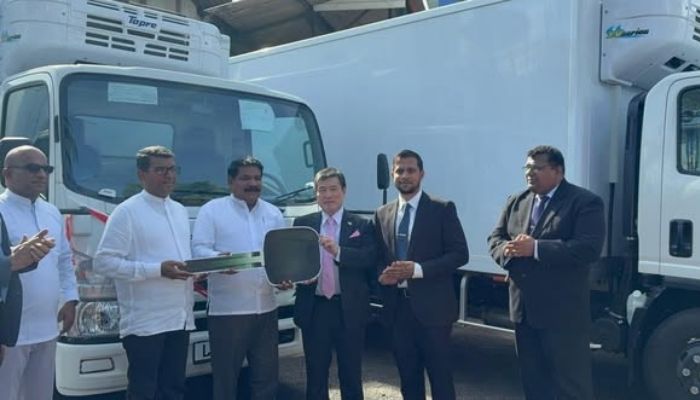
Japan handed over six refrigerated trucks to the Ceylon Fisheries Corporation on Wednesday under a Rs. 1.25 million US dollar (200 million Yen) grant aimed at cutting post-harvest fish losses in the Northern and Eastern Provinces, Newswire reported.
Japanese Ambassador Akio Isomata presented the vehicles to CFC Chairman Mohammad Nowras Nasar in the presence of Fisheries, Aquatic and Ocean Resources Minister Ramalingam Chandrasekar and Deputy Minister Ratna Gamage.
The grant forms part of Japan’s Economic and Social Development Programme. Alongside the trucks, the project includes the installation of three ice-making machines in Jaffna, Mullaitivu and Trincomalee. According to the Japanese Embassy, Sri Lanka’s fisheries sector faces major challenges in transporting fish from the North and East to Colombo, with inadequate temperature control contributing to post-harvest losses of up to 40 percent.
The six trucks will be operated by the CFC to move marine products from those regions to Colombo, preserving product quality, reducing wastage and improving distribution.
“A cold chain is not merely a technology or logistics system for cooling fish; it is the vital foundation that protects the hard work of fishermen, secures the trust of consumers, and supports national food security,” Ambassador Isomata said. He noted that strengthening the cold chain had become “increasingly important amid concerns over rising food and fuel prices linked to the current situation in the Middle East.”
Minister Chandrasekar described the donation as a significant step toward modernising the country’s fisheries infrastructure.
The grant is the latest tranche of Japanese fisheries-sector support, building on a broader bilateral assistance programme that has prioritised the Northern and Eastern Provinces since reconstruction began. Cutting a 40 percent post-harvest loss rate by even a few percentage points would meaningfully expand the supply of usable catch to the southern wholesale markets and reduce price pressure on local consumers.
Japan is also a partner in ongoing fisheries monitoring — separately, Norway and Sri Lanka signed a fisheries AIS and Blue Justice agreement to combat illegal fishing in the same Northern and Eastern waters. Minister Chandrasekar had earlier attended the Japan-Sri Lanka fisheries dialogue at the Ocean Summit in Tokyo in June.