South Korean police are seeking an arrest warrant for a YouTuber who allegedly used an AI-generated voice recording and fabricated text messages to defame actor Kim Soo-hyun, fuelling a scandal that ended one of the country’s most prominent acting careers.
Authorities say YouTuber Kim Se-ui, who has nearly a million followers, manipulated screenshots of text messages and shared an audio file generated by AI to create the impression that Kim Soo-hyun had dated actress Kim Sae-ron when she was still a minor. The allegations surfaced shortly after Kim Sae-ron killed herself at age 24.
The voice recording, which appeared to feature the actress saying she had been dating Kim Soo-hyun since middle school, was posted online months after her death. Police say forensic analysis has now confirmed the recording was synthetically generated and that the accompanying text-message screenshots were edited to falsely suggest exchanges between the two.
Police allege the YouTuber knowingly spread the false claims for financial gain. His actions “collapsed Kim Soo-hyun’s social base and his economic activities across the board, and destroyed the basis for his professional survival,” according to a police filing reported by JoongAng Ilbo. Officers say the actor remains under psychiatric treatment.
The YouTuber has posted a video claiming the police case is a “subterfuge meant to disrupt his investigation”.
Kim Soo-hyun, a household name in South Korea who starred in major hit dramas and advertisements, has not made an official public appearance since the scandal broke. The release of his Disney+ series Knock-Off has been indefinitely postponed.
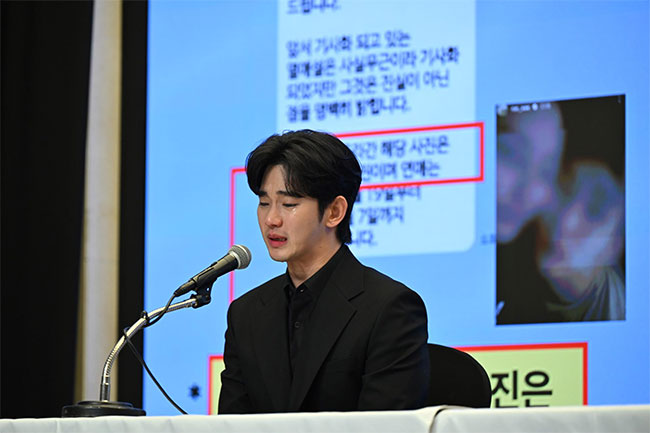
The actor admitted at a tearful press conference in March 2025 that he had dated Kim Sae-ron — but only when she was an adult — and filed criminal complaints against the YouTuber and the actress’s family. South Korean celebrities are held to exceptionally high public standards, with careers ending over allegations far less serious than the false claims levelled against Kim Soo-hyun.
The case is one of the most consequential examples to date of generative AI being used as the central evidence vehicle in a real-world defamation campaign. It is likely to renew calls in South Korea and elsewhere for clearer legal frameworks around AI-fabricated evidence, particularly in jurisdictions where deepfaked audio and text-message fabrication remain unevenly regulated. In Sri Lanka, the PSTA draft bill reached the Justice Ministry in May, and a BBC Panorama investigation documented AI-generated disinformation pages linked to Sri Lanka-based operators.
Source: BBC, via Ada Derana.