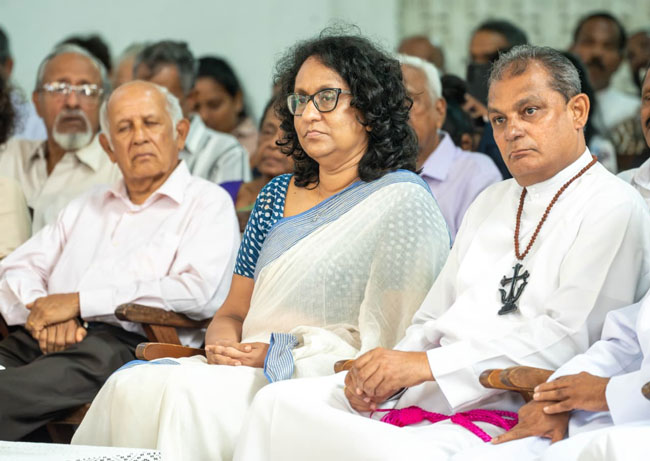
Prime Minister Dr. Harini Amarasuriya has delivered the Bishop Cyril Abeynayake Memorial Lecture at the Cathedral of Christ the Living Saviour, addressing a distinguished gathering on the theme “Shaping the Future of Education in 21st Century Sri Lanka and Beyond,” Ada Derana reported.
Attending the ceremony at the invitation of the Bishop of Colombo, Rt. Rev. Dushantha Rodrigo, the Prime Minister highlighted Sri Lanka’s tradition of multi-faith collaboration and plurality as embodied by the Anglican Church.
In her address, the Prime Minister re-evaluated the historical trajectory of Sri Lanka’s educational policy. She referenced the landmark 1971 ILO Seers Report, which diagnosed the country’s economic challenges through the lens of a “skills mismatch” and the “queuing phenomenon” associated with public sector employment. Although decades of subsequent reforms heavily favoured STEM, technical education and “soft skills” in response to market demands, those initiatives had failed to resolve the underlying structural crises, she said.
The Prime Minister urged a return to the foundational principles of the Kannangara Reforms (1943–1947), emphasising that free education was never intended merely to train a future labour force for corporate interests. Its visionary purpose was to cultivate politically aware, morally grounded and critically engaged citizens essential to a robust democracy, the PM’s Office said. “Education was expected to produce the kinds of citizens required for a newly independent democratic nation-state,” she said, noting that early elite resistance had sought to limit the social mobility of the rural poor.
The Prime Minister identified five fundamental crises the proposed state reforms seek to address: the widening gap between elite and non-elite institutions, with even state-owned elite schools continuing to reproduce societal privilege; the historical failure to nurture politically mature and analytical citizens envisioned by post-independence reformers; the stark disconnect between women’s strong academic performance and their comparatively low labour force participation, constrained by an unequal burden of domestic care work; the urgent need to keep pace with rapid technological disruptions, particularly the rise of artificial intelligence; and the shift from viewing education as a transformative life experience to treating it as a transactional pursuit centred solely on paper qualifications.
Adapting to AI required deep systemic transformation, enhanced digital literacy and strengthened online safety measures rather than superficial curriculum adjustments alone, she said. Meaningful reform could not be achieved merely by revising curricula, but required a comprehensive transformation of structures, institutions and the broader teaching and learning environment.
Education should open expansive pathways for students rather than narrow their horizons, the Prime Minister said. The system must rebuild parent trust, moving away from an atmosphere of suspicion, and teaching must be restored as a respected and prestigious profession chosen for its transformative impact rather than viewed as a “fallback” or “safe” career option.
Concluding, the Prime Minister reaffirmed that the ultimate goal of educational reform is to cultivate respected leaders across religion, the economy, politics, the arts and community life. The lecture extends a body of work from the Prime Minister that includes her Oxford OSGA lecture on Sri Lanka’s care economy and politics of development, the Grade 6 education reforms scheduled for January 2027, preschool education reforms targeted for 2027 and the medical education expert committee appointed in late May.