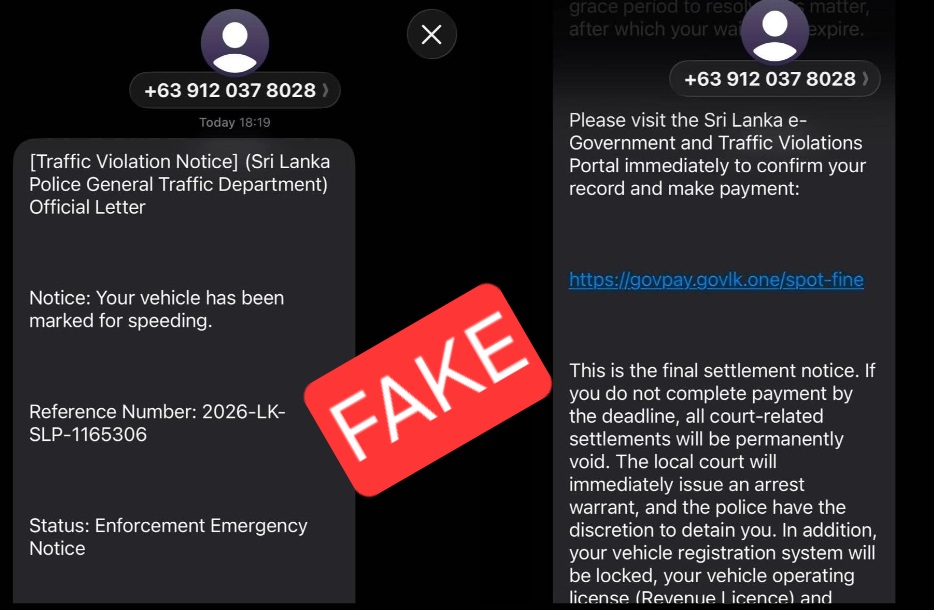
Sri Lanka Police have warned motorists about a scam involving fake SMS and WhatsApp messages claiming the recipient has committed a traffic offence captured on CCTV cameras.
In a statement, the Police Media Division said the messages are sent from fake phone numbers and crafted to appear as though they were issued by the Sri Lanka Police. Recipients are directed to a fraudulent website and instructed to pay a fine for the alleged violation.
Police said the bogus website has been designed to closely resemble the official GovPay payment platform in an attempt to mislead the public. Anyone who accesses the site and tries to make a payment risks having sensitive information — including credit card details — stolen by the scammers.
The Police Media Division urged the public not to click on suspicious links received via SMS or WhatsApp and to treat such messages with caution. It clarified that traffic fines should only be paid after a motorist has been officially informed of an offence by a police officer and has received an official fine slip through the genuine GovPay system.
The Sri Lanka Computer Emergency Readiness Team (SLCERT) followed with its own public alert a day later, confirming the scam is active across SMS and WhatsApp and that the fraudulent site is engineered to capture credit and debit card details entered during the fake payment flow. SLCERT urged the public not to click on suspicious links and to report such messages to the relevant authorities.
The warning is the latest in a run of impersonation-based frauds flagged by authorities. Police have previously cautioned over officers impersonating law enforcement in cyber scams, a malicious APK banking scam spread via WhatsApp and Telegram, and a fake government website harvesting digital-identity data. The common thread is a lookalike official platform engineered to capture payment or personal data.
Update — June 8: Police issued a fresh public alert over a new variant of the same scam, Newswire reported. The current message purports to come from the Sri Lanka Police Department and tells recipients they were “recorded committing a traffic offence by a smart tracking device”, urging payment through a suspicious site or an appeal before a deadline. It threatens additional penalties, daily late-payment charges and inclusion in national driver and credit databases if payment is not made. The fraudulent link directs users to a website ending in “.cfd” — not an official Sri Lankan government domain. Police repeated that no such facility exists and that traffic fines are issued only after a motorist has been formally informed of an offence by a police officer.
Update — July 14: Police renewed the warning more than six weeks on, with the scam still circulating. They reiterated that messages demanding payment of fines for traffic offences are not issued by the Traffic Division, and Deputy Inspector General W.P.J. Senadheera, of the Traffic Control and Road Safety Range, urged the public not to respond to them, NewsFirst reported.