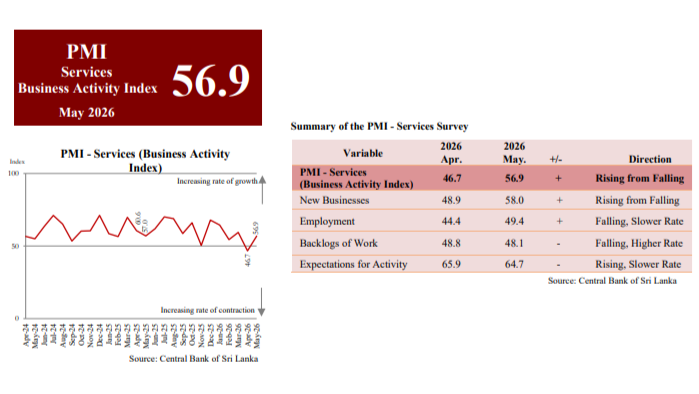
Sri Lanka’s services sector swung back to expansion in May 2026, with the Central Bank’s Purchasing Managers’ Index for services rising to 56.9 from 46.7 in April, EconomyNext reported on Tuesday.
The 10.2-point jump reverses April’s contraction — the first sub-50 reading since April 2023 — when fuel-price shocks, festive-season holidays and the tourism slowdown weighed on output. A PMI above 50 indicates month-on-month expansion.
The rebound was led by financial, professional and other personal services. Real estate, IT programming and goods transportation also recorded notable growth, the Central Bank said in commentary released with the data. New business volumes also rose, supported by financial and professional services as well as wholesale and retail trade, other personal services and goods transportation.
The PMI improvement still came with two persistent soft spots. Employment declined further in May because of contract expirations, retirements and resignations, continuing a trend reported through the post-pandemic recovery cycle. Backlogs of work also fell at a faster pace than the previous month, suggesting service providers cleared outstanding orders more aggressively than they took on new ones.
The reading lands as the CSE’s ASPI jumped 743 points on Monday on US–Iran deal optimism and the rupee closed at 335.00/335.25 to the dollar in Tuesday’s spot market. Both moves signal that the financial-services rebound captured by the May PMI may be sustaining into June if the post-Hormuz risk premium continues to ease.
A separate PMI release for construction this cycle registered 45.7 in April, and EconomyNext’s running PMI series shows manufacturing also contracted sharply in April.
Update — June 17: Manufacturing PMI 56.6 confirms parallel rebound
The Central Bank released the manufacturing PMI on Wednesday at 56.6 for May, confirming a return to expansion in industrial activity alongside the services rebound, Ada Derana reported. All sub-indices remained above the neutral threshold despite external pressures linked to the Middle East conflict, the CBSL said.
Growth in new orders and production was primarily driven by the food and beverage sector and by textiles and wearing apparel. Higher output was also supported by an increase in working days compared with April, when the Sinhala-Tamil New Year holiday week and limited fuel availability had constrained factory hours. The stock of purchases rose in line with rising demand and production levels.
Looking ahead, business expectations for the coming quarter remain positive, supported by anticipated growth in tourist arrivals during the Perahera season and improving domestic economic conditions, the Central Bank said.
Sources: