Sri Lanka has completed a four-year initiative to modernise its shrimp aquaculture sector under a Food and Agriculture Organization (FAO) project funded by South Korea, introducing a national digital monitoring platform, IoT-based water-quality sensors and the country’s first GIS-mapped shrimp farm registry.
The project, titled “Smart and Sustainable Aquaculture through Effective Biosecurity and Digital Technology,” was implemented by the FAO in collaboration with the Ministry of Fisheries, Aquatic and Ocean Resources, with financial support from the Government of the Republic of Korea, NewsFirst reported.
Among its key outputs is the new National Strategy on Aquatic Animal Health — supported by a national aquatic pathogen list, disease profiles for major shrimp illnesses and findings from a nationwide survey of 699 shrimp farms. The project also delivered GIS-based mapping of farm locations, upgrades to National Aquaculture Development Authority (NAQDA) laboratory diagnostics, and updated Better Management Practices guidelines.
The most technically significant new piece of infrastructure is the National Shrimp Industry Information System (SIIS), a digital platform that integrates farm-level and national data for real-time monitoring. The system uses IoT-enabled sensors to track water-quality indicators and issues early warning alerts so farmers and regulators can respond quickly to emerging risks. All shrimp farms in the Northwestern Province — Sri Lanka’s main farming belt — have already been mapped under the SIIS.
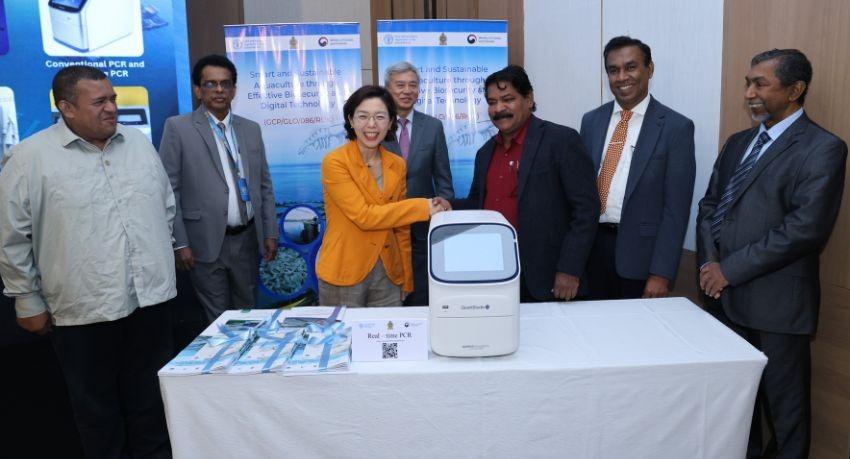
Korean Ambassador Miyon Lee reaffirmed Korea’s role as a development partner and commended the FAO’s work on sustainable aquaculture. She said continued support would help Sri Lanka transition to more efficient aquaculture systems through digital technology while contributing to rural livelihoods and food security.
Training was a central component: 450 shrimp farmers and 190 government officials were trained in disease diagnostics, water quality monitoring, biosecurity practices and digital data management. A separate strategic plan for food-safety regulatory frameworks and laboratory capability is intended to improve export-market access.
Sri Lanka has separately signed a Norway-backed AIS tracking agreement for its fishing fleet and the FAO has flagged the impact of global conflict on food prices as a broader risk to the sector. The government has also distributed FAO-supported fertiliser vouchers to farmers recovering from Cyclone Ditwah.
Source: NewsFirst — Sri Lanka Elevates Shrimp Aquaculture with High-Tech, Biosecure Overhaul.