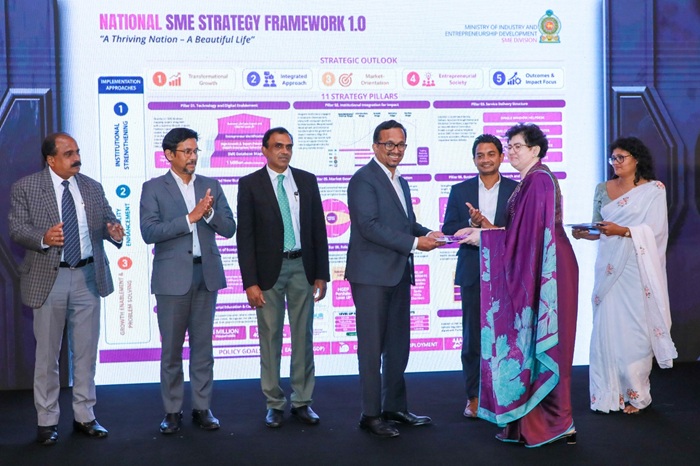
The “SME Nexus” National SME Strategy Framework 2026, aimed at empowering Sri Lanka’s small and medium enterprises, was officially launched on Wednesday under the patronage of Industry and Entrepreneurship Development Minister Sunil Handunneththi and Deputy Minister Chathuranga Abeysinghe.
According to the Ministry, the initiative seeks to remove structural barriers facing the SME sector, which represents more than 75 percent of registered businesses in Sri Lanka, contributes 52 percent to gross domestic product, and employs 45 percent of the national workforce. Developed in line with the government’s “A Thriving Nation – A Beautiful Life” vision, the framework is designed to guide entrepreneurs from sustaining day-to-day livelihoods to becoming high-growth, export-oriented enterprises.
The framework rests on a core strategic vision and 11 strategic pillars to be implemented across the SME ecosystem. Key focus areas include technological and digital empowerment through an integrated SME data platform; institutional integration aligning all enterprise development state institutions toward a unified national objective; a “single-window” service-delivery structure with an “SME Connect” call centre; simplified incubation and start-up registration; and market development through linkages to global value chains.
Other pillars cover business intelligence and research through the SIBA unit, formal recognition of ecosystem partners (banks, chambers of commerce and public officials), training of development officers as “Relationship Officers” to mentor entrepreneurs, improved credit readiness alongside a dedicated “Growth Fund” for priority sectors, the promotion of entrepreneurship education at school and university levels, and reform of laws and regulations that hinder enterprise growth.
The launch comes alongside a broader government push to clear SME bottlenecks. Earlier this cycle, LB Finance partnered with Qapital on a $15 million MSME enabling line, the Industry Ministry recorded Rs. 31 billion in Q1 SME loans, and Minister Handunneththi separately briefed the IMF mission on the industrial-SME track. Critics including SJB MPs have argued that renewable-energy SMEs are sitting on Rs. 10 billion in unpaid NSO dues, and that banks have been slow to disburse a Rs. 95 billion credit line — concerns the new framework’s “credit readiness” pillar appears designed to address.