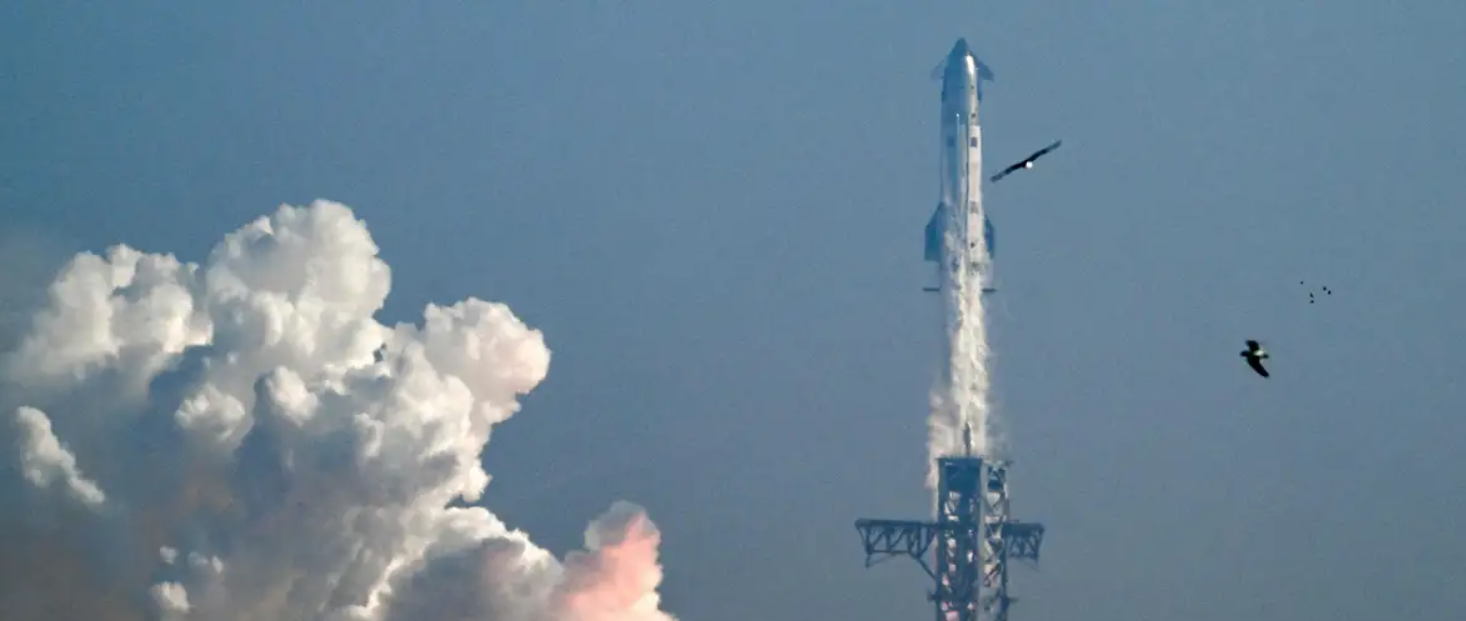
SpaceX launched the third-generation Starship V3 on Friday, the largest and most powerful rocket ever flown, in a test flight that ended with a planned splashdown and fiery explosion in the Indian Ocean.
Standing more than 407 feet (124 metres) when fully stacked, the rocket lifted off from the southern tip of Texas just after 5:30 pm local time (2230 GMT). The flight lasted roughly an hour before the vehicle impacted the Indian Ocean and erupted in flames as designed. SpaceX employees broke into cheers on the company’s livestream.
“You scored a goal for humanity,” Elon Musk wrote on X after the launch.
The mission was the 12th test flight of the Starship programme and the first for the upgraded V3 design. The launch was delayed by a day after a malfunctioning hydraulic pin in the launch tower forced engineers to scrub Thursday’s attempt. According to the BBC, the rocket achieved most of its key objectives, though both stages suffered engine failures during the flight.
Ahead of liftoff, NASA Administrator Jared Isaacman said the agency was eager to see the vehicle perform: “We’re looking forward to seeing this fly, because hopefully at some point in the not too distant future we’re going to join up in Earth orbit.”
Starship is central to NASA’s Artemis Program, which aims to land astronauts on the Moon for the first time in more than 50 years. NASA is paying both SpaceX and Jeff Bezos’s Blue Origin billions of dollars to build lunar landers for Artemis crews. China is separately targeting 2030 for its first crewed Moon mission.
The test comes as SpaceX prepares for what could be the largest initial public offering in history next month. Sri Lanka recently approved a national space policy framework, and the Artemis II crew returned to Earth in April after the first crewed deep-space voyage since Apollo 17.