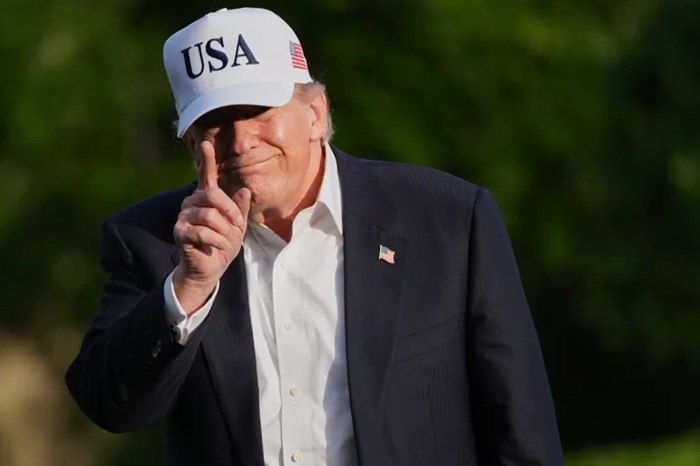
US President Donald Trump said an agreement involving the United States, Iran and several Middle Eastern countries had been “largely negotiated”, with final details expected to be announced soon.
In a statement shared on social media early Sunday Sri Lanka time, Trump said he held discussions with leaders from Saudi Arabia, the United Arab Emirates, Qatar, Pakistan, Türkiye, Egypt, Jordan and Bahrain on a proposed peace framework linked to Iran. The agreement remained subject to finalisation between Washington, Tehran and the other countries involved.
Trump claimed the Strait of Hormuz would be reopened under the proposed deal, a central demand that has dominated negotiations throughout the conflict. The waterway, through which roughly a fifth of global oil supplies pass, has been the principal economic pressure point of the war and the direct cause of Sri Lanka’s fuel rationing and rising import costs.
The US President also said he separately spoke with Israeli Prime Minister Benjamin Netanyahu, adding the discussions “went very well”.
International media outlets including Reuters and the Associated Press reported negotiations were still ongoing. Iranian officials described the proposal more cautiously as a “framework agreement” requiring further discussions, reflecting a gap between Washington’s confident framing and Tehran’s more conditional language.
The announcement marks a significant escalation in optimism after Secretary of State Marco Rubio said only a day earlier in New Delhi that talks had made “some progress, but not there yet”. It also follows Tehran’s closure of western airspace on Saturday over fears of further US strikes — a move that suggested a hardening rather than softening of positions.
Pakistan’s army chief travelled to Tehran on Friday as part of mediation efforts to secure a political solution, and Pakistan is among the eight countries Trump named as part of the framework.
A confirmed Hormuz reopening would directly ease Sri Lanka’s fuel supply constraints, which have driven CPC diesel costs above $281 per barrel on recent shipments and pushed Brent crude to multi-year highs over recent weeks.
A day after the “largely negotiated” claim, Trump struck a more measured tone, saying Washington would “not rush into a deal” with Tehran. “Both sides must take their time and get it right. There can be no mistakes,” he wrote on social media, adding that the US blockade of Iranian ports would remain in “full force and effect” until an agreement is reached. He reiterated that Iran “cannot develop or procure a nuclear weapon”.
A senior US administration official told CNN that an agreement was not expected to be signed immediately and that key terms were still being worked out. Iran has committed in principle to reopen the Strait of Hormuz and dispose of its stockpile of highly enriched uranium, but the method of disposal, the length of any moratorium on future enrichment and the specific dollar value of sanctions relief remain unresolved. Officials said sanctions relief and the unfreezing of Iranian assets would follow only after the Strait reopens and Tehran honours its commitments. According to a regional source briefed on the talks, the deal would unfold in two phases — an initial reopening of Hormuz to pre-war traffic alongside nuclear-weapon assurances and a resumption of Iranian fuel and oil sales, followed by a 30-to-60-day phase of detailed nuclear negotiations.