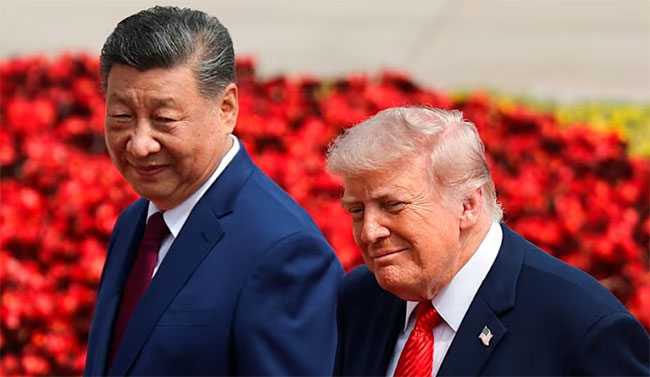
US President Donald Trump said Chinese President Xi Jinping personally offered to help resolve the war between the United States and Iran during their Beijing talks on Thursday, but Secretary of State Marco Rubio rejected the framing within hours, telling NBC News that Washington had not asked for and did not need Chinese assistance.
“President Xi would like to see a deal made. He would, he would like to see a deal made. And he did offer. He said, ‘If I can be of any help at all, I would like to be of help,’” Trump told Fox News host Sean Hannity in an interview taped after the first day of high-stakes discussions. Trump added that Xi “would like to see the Hormuz Strait open” — a point of direct interest to fuel-importing economies including Sri Lanka.
Rubio, speaking separately to NBC, played down any suggestion that the administration was seeking Beijing’s leverage. “We raised the issue to make clear what our position is and to make it clear so they understand, because it’s logical. We would talk about it, given how dominant that issue is,” he said, adding that “we don’t need their help.”
The public split between the president and his top diplomat is the first significant daylight between the two on the Iran file since the summit began. China is the world’s largest consumer of Iranian crude and the country Washington has long viewed as the most economically capable of pressuring Tehran.
A White House readout earlier on Thursday said both leaders had agreed the Strait of Hormuz “must remain open” for the free flow of energy, and that Beijing opposed militarisation of the waterway or any toll regime. The summit was also expected to cover fentanyl precursor chemicals and Chinese purchases of US agricultural products, but Iran was the most diplomatically charged item on the agenda.
For Sri Lanka, the Hormuz dimension is the most direct stake. Colombo has carried a Hormuz risk premium on every diesel shipment since the war began, and any de-escalation backed by Beijing would feed quickly into landed fuel costs.
Source: Ada Derana (citing CNN).