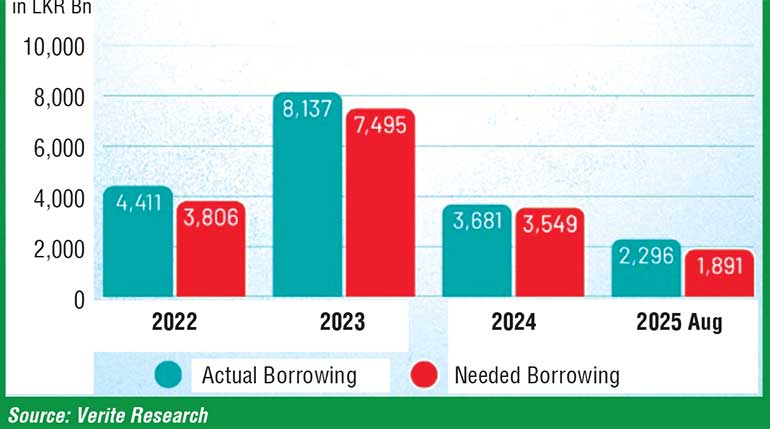
Sri Lanka’s headline improvement in Treasury cash balances reflects excess borrowing rather than a strengthening fiscal position, with the government having borrowed Rs. 1.78 trillion more than its financing needs over 2022–August 2025, the policy think tank Verité Research said.
The Treasury cash buffer swung from a deficit of Rs. 832 billion at the start of 2022 to a surplus of Rs. 1.205 trillion by August 2025. “At first glance, that looks like a striking fiscal turnaround,” Verité said, “but that reading is incomplete. This rise in cash balances did not come from revenue left over after the Government met its expenses. It came from borrowing more than was needed at the time and holding the excess as cash in the Treasury.”
The clearest example was 2023, when the cash buffer grew the most. Total financing need was Rs. 7,495 billion — Rs. 5,331 billion in debt repayments plus a Rs. 2,164 billion budget deficit — yet the government borrowed Rs. 8,137 billion, around Rs. 642 billion more than required. The same pattern repeats across the four-year period.
Verité likened the dynamic to a borrower who takes a loan and parks it in a bank account: liquidity rises but so does debt, leaving the net asset position unchanged. In Sri Lanka’s case, the cash held earns interest at a lower rate than the cost of the borrowing that funded it, generating a net interest loss for every day the balance is retained.
The think tank acknowledged that a buffer can ease short-term liquidity pressure and allow the Treasury to push back at bond auctions when yields are too high. However, “when the cash balance is in excess of liquidity requirements, the fiscal outcome is negative — because it increases the debt and interest burden.”
The note follows a sharp month-on-month improvement in the underlying fiscal position. In January 2026, the primary surplus rose 86.7% year-on-year to Rs. 222.82 billion and the overall budget deficit narrowed 96.8% to Rs. 3.81 billion, with revenue up 35.3% on stronger tax collection and expenditure contained at 1.4% growth. The improvement came despite a Rs. 500 billion post-Ditwah supplementary allocation and has created space for a Rs. 100 billion short-term relief package against the global energy shock.