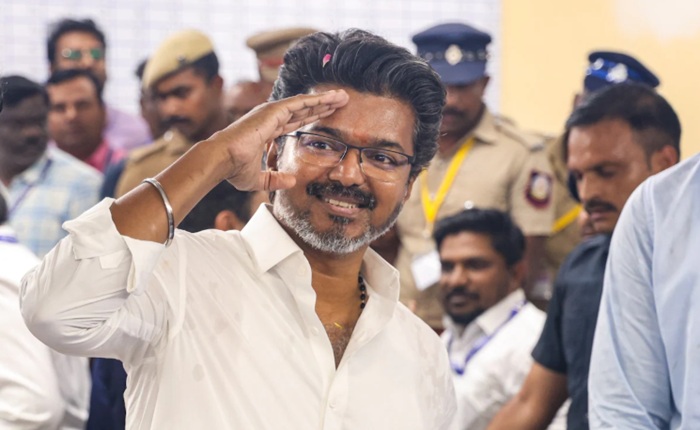
Tamil Nadu Governor Rajendra Arlekar on Thursday turned down TVK chief Vijay’s claim to form the government for the second day in a row, demanding he return only after securing the written backing of 118 legislators before any swearing-in can proceed.
“Please come with 118 signatures. Prove that TVK has the majority and then the oath can happen,” the Governor told Vijay during a Raj Bhavan meeting on May 7, Newswire reported. The Governor also assured the actor-turned-politician that no other party would be invited to form the government in the meantime. The Tamil Nadu Assembly’s tenure ends on May 9.
Vijay had presented the backing of 112 MLAs on Wednesday — short of the magic number — and met the Governor a second time on Thursday with no improvement in the count. AIADMK leader Edappadi K. Palaniswami has not sought an appointment with the Governor.
TVK emerged as the single-largest party with 108 seats in the 234-member Assembly, falling 10 short of the majority mark of 118. The DMK finished second with 59 seats and the AIADMK third with 47. Congress, until recently a DMK ally, won 5 seats and has already offered to back TVK, lifting Vijay’s count to 113.
Insiders told NDTV that TVK is also courting other former DMK allies — the CPI (2), CPM (2) and VCK (2) — to clear the threshold. Smaller parties on the floor include the PMK with 4 seats and the BJP, DMDK and AMMK with one each. Vijay won both Perumbur and Trichy East and will have to vacate one, while the appointment of a Speaker reduces TVK’s effective bench to 106. The adjusted majority figure is 117.
If TVK shows the required numbers, the Governor can invite Vijay to form the government, possibly with a floor test under Articles 174 and 175(2) of the Indian Constitution. If not satisfied, the Governor’s discretionary power under Articles 163 and 164 allows him to invite the second-largest party — the DMK — to attempt formation instead.
Outgoing Chief Minister M. K. Stalin lost his Kolathur stronghold on counting day and has formally resigned. BJP leader Tamilisai Soundararajan described Vijay’s win as “an anti-wave against MK Stalin, the misgovernance of the DMK and the highly disturbed law-and-order situation.”
The transition matters for Sri Lanka’s Tamil affairs. Tamil Nadu state policy on the Palk Strait fishing dispute, prisoner repatriation and Indo–Sri Lanka cultural ties has historically tracked closely with whoever sits in Fort St. George.
Sri Lankan diplomatic outreach has been swift. Former President Chandrika Bandaranaike Kumaratunga wrote to Vijay on Wednesday, describing his victory as a “remarkable achievement” and expressing hope for continued friendly relations between Sri Lanka and Tamil Nadu under his leadership.
In Parliament on May 6, opposition MP Jeevan Thondaman congratulated Vijay and laid out a Sri Lankan agenda for him to consider once he is sworn in. Thondaman urged the incoming chief minister to help Sri Lankans living in refugee camps in Tamil Nadu, to engage with the long-running Palk Strait fishermen dispute, and to support efforts to give “rightful identity to the hill country Tamils” — the plantation Tamil community Thondaman represents. He also invited Vijay to visit Sri Lanka after taking office, framing a possible Tamil Nadu transition as “an opportunity for Sri Lanka and Tamil Nadu to move toward a new chapter… built on respect, trust and people-to-people ties.”